The Film
A political biography told through one decisive year
Archival cinema, original interviews and a jazz-led score reconstruct how Robeson became a symbol fought over by competing powers.
Approach
The film moves between Robeson’s public performances and the machinery surrounding them: newsrooms, diplomatic pressure, surveillance, concert promotion and organized violence.
Structure
- Zenith: 1943–44 and the “safe icon” of Americana.
- Fracture: Paris and Moscow, April–June 1949.
- Crucible: Peekskill, August–September 1949.
- Isolation: blacklisting and passport revocation, 1950–58.
Method
Claims are tied to visible sources. Disputed passages are presented as disputes, allowing audiences to inspect language, provenance and context.
The Film / Storyboard
The voice. The crowd. The road home.
The Rise and Fall of America’s Number One Negro: Paul Robeson in 1949
Read the complete photographic storyboard
Explore all 44 pages of the current development storyboard: archival images, narration, editing notes and research references across the 1944–1950 chronology. Version 3, 8 November 2026. Eighteen sequences; proposed running time: 32 minutes.
Each panel preserves the complete visual board. Select “Read page text” for its text, or enlarge the panel to examine archival documents. Source reports and allegations are identified as such; research gaps and image-clearance requirements remain visible.
01 / Cover - version 3
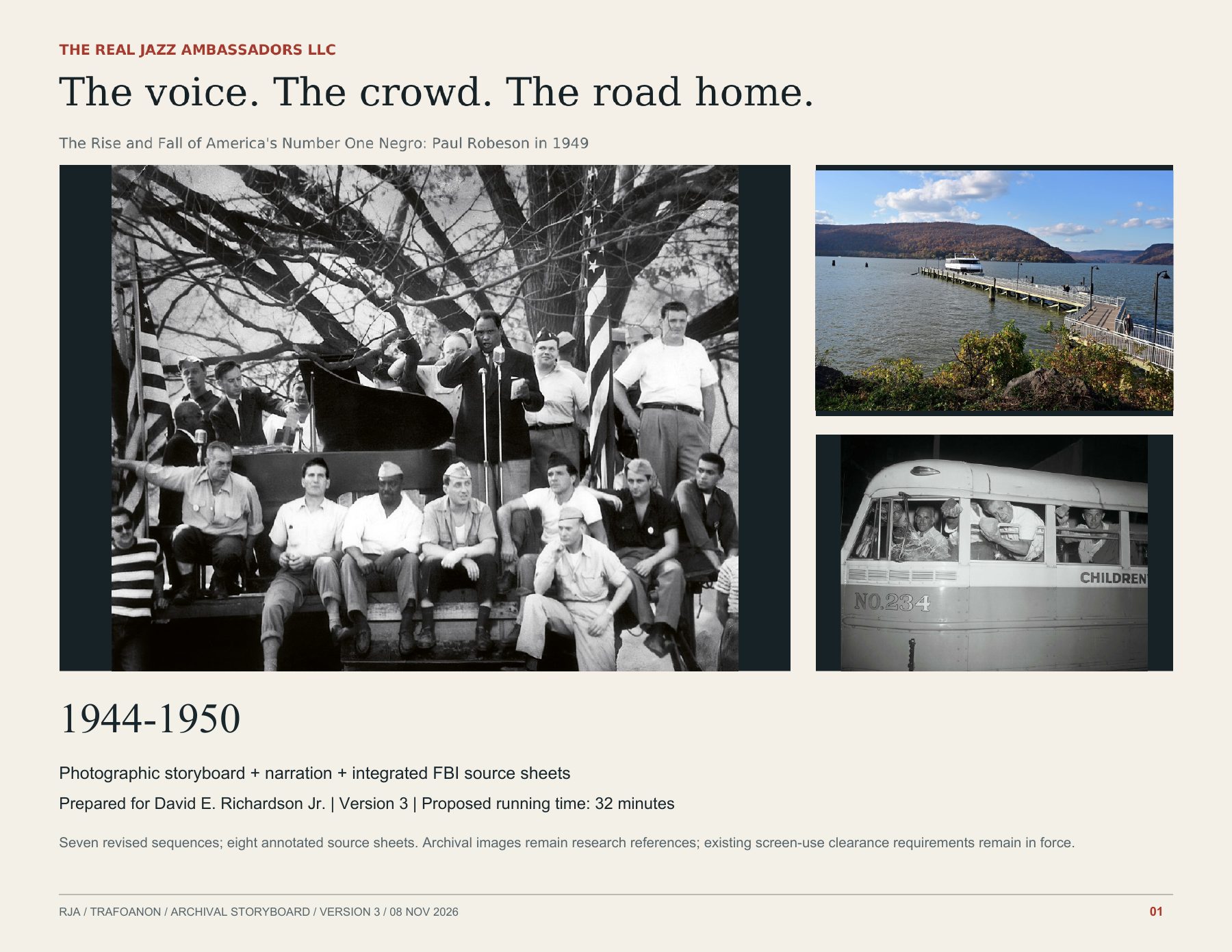 Enlarge this panel
Read page 1 text
The Rise and Fall of America’s Number One Negro: Paul Robeson in 1949
The voice. The crowd. The road home.
1944–1950. Photographic storyboard, narration and integrated FBI source sheets. Prepared for David E. Richardson Jr. Version 3. Proposed running time: 32 minutes. Seven revised sequences and eight annotated source sheets. Archival images remain research references; existing screen-use clearance requirements remain in force.
02 / Make the people and places carry the history.
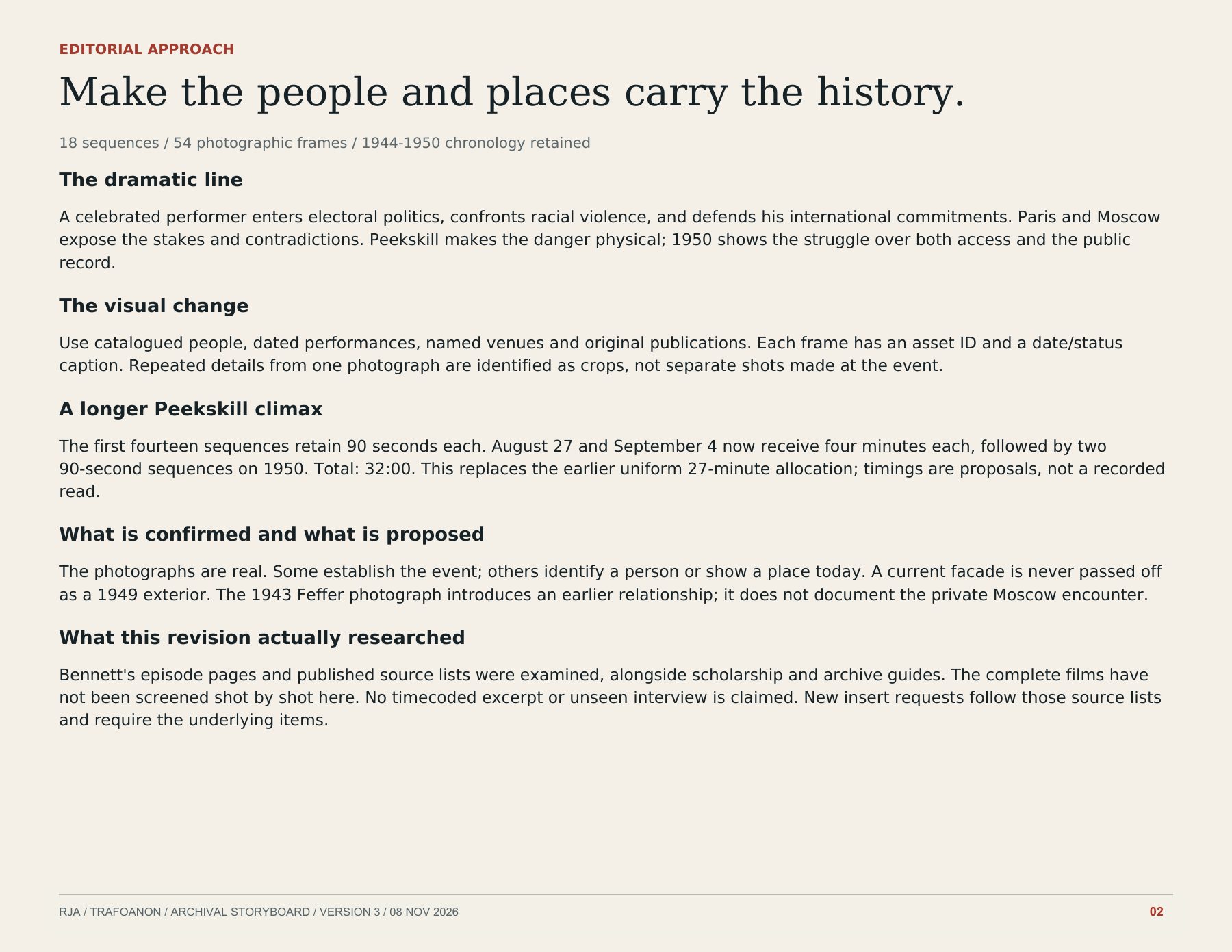 Enlarge this panel
Read page 2 text
EDITORIAL APPROACH
Make the people and places carry the history.
18 sequences / 54 photographic frames / 1944-1950 chronology retained
02
The dramatic line
A celebrated performer enters electoral politics, confronts racial violence, and defends his international commitments. Paris and Moscow
expose the stakes and contradictions. Peekskill makes the danger physical; 1950 shows the struggle over both access and the public
record.
The visual change
Use catalogued people, dated performances, named venues and original publications. Each frame has an asset ID and a date/status
caption. Repeated details from one photograph are identified as crops, not separate shots made at the event.
A longer Peekskill climax
The first fourteen sequences retain 90 seconds each. August 27 and September 4 now receive four minutes each, followed by two
90-second sequences on 1950. Total: 32:00. This replaces the earlier uniform 27-minute allocation; timings are proposals, not a recorded
read.
What is confirmed and what is proposed
The photographs are real. Some establish the event; others identify a person or show a place today. A current facade is never passed off
as a 1949 exterior. The 1943 Feffer photograph introduces an earlier relationship; it does not document the private Moscow encounter.
What this revision actually researched
Bennett's episode pages and published source lists were examined, alongside scholarship and archive guides. The complete films have
not been screened shot by shot here. No timecoded excerpt or unseen interview is claimed. New insert requests follow those source lists
and require the underlying items.
02
03 / Version 3 source integration guide
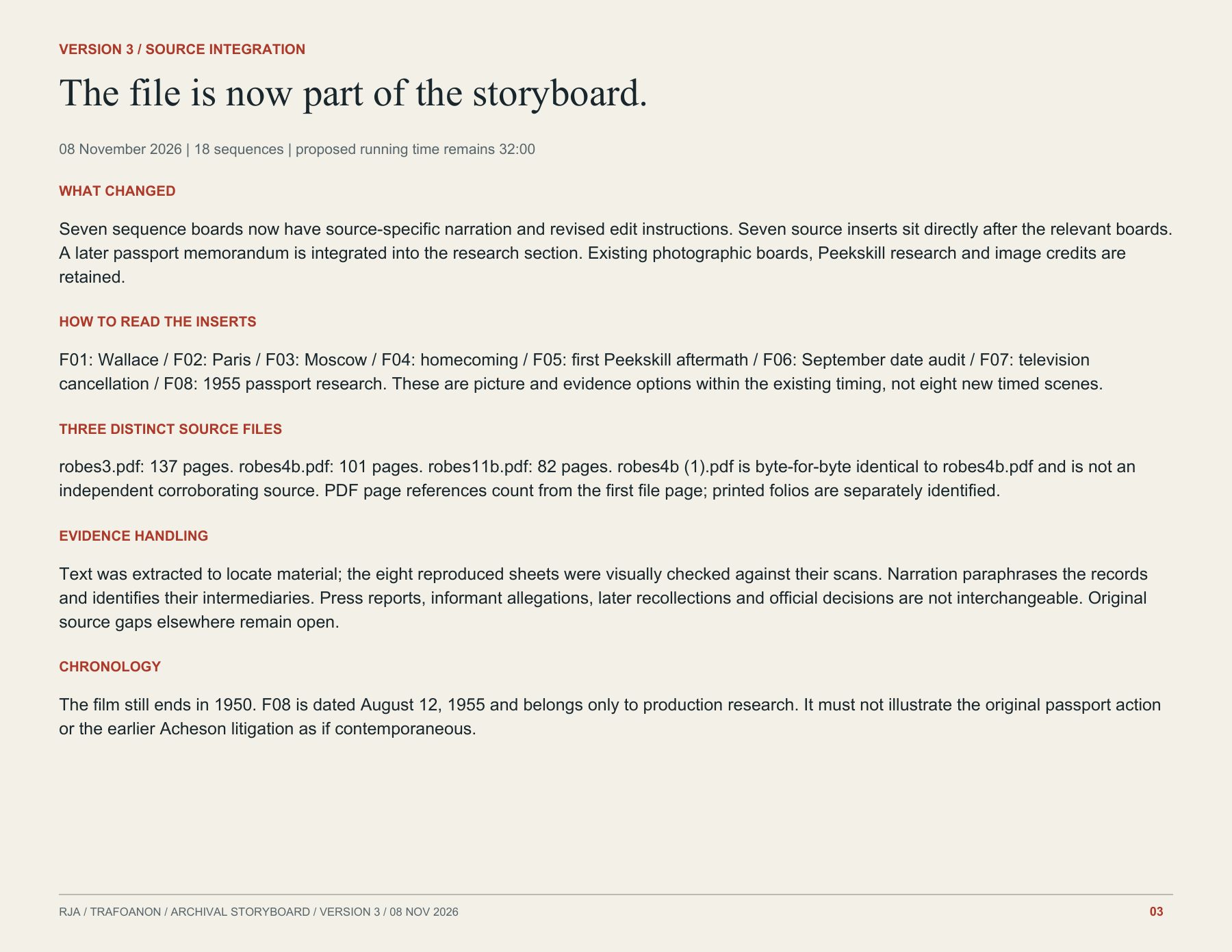 Enlarge this panel
Read page 3 text
VERSION 3 / SOURCE INTEGRATION
The file is now part of the storyboard.
08 November 2026 | 18 sequences | proposed running time remains 32:00
WHAT CHANGED
Seven sequence boards now have source-specific narration and revised edit instructions. Seven source inserts sit directly after the relevant boards.
A later passport memorandum is integrated into the research section. Existing photographic boards, Peekskill research and image credits are
retained.
HOW TO READ THE INSERTS
F01: Wallace / F02: Paris / F03: Moscow / F04: homecoming / F05: first Peekskill aftermath / F06: September date audit / F07: television
cancellation / F08: 1955 passport research. These are picture and evidence options within the existing timing, not eight new timed scenes.
THREE DISTINCT SOURCE FILES
robes3.pdf: 137 pages. robes4b.pdf: 101 pages. robes11b.pdf: 82 pages. robes4b (1).pdf is byte-for-byte identical to robes4b.pdf and is not an
independent corroborating source. PDF page references count from the first file page; printed folios are separately identified.
EVIDENCE HANDLING
Text was extracted to locate material; the eight reproduced sheets were visually checked against their scans. Narration paraphrases the records
and identifies their intermediaries. Press reports, informant allegations, later recollections and official decisions are not interchangeable. Original
source gaps elsewhere remain open.
CHRONOLOGY
The film still ends in 1950. F08 is dated August 12, 1955 and belongs only to production research. It must not illustrate the original passport action
or the earlier Acheson litigation as if contemporaneous.
03
04 / Three parts, with Peekskill as the climax.
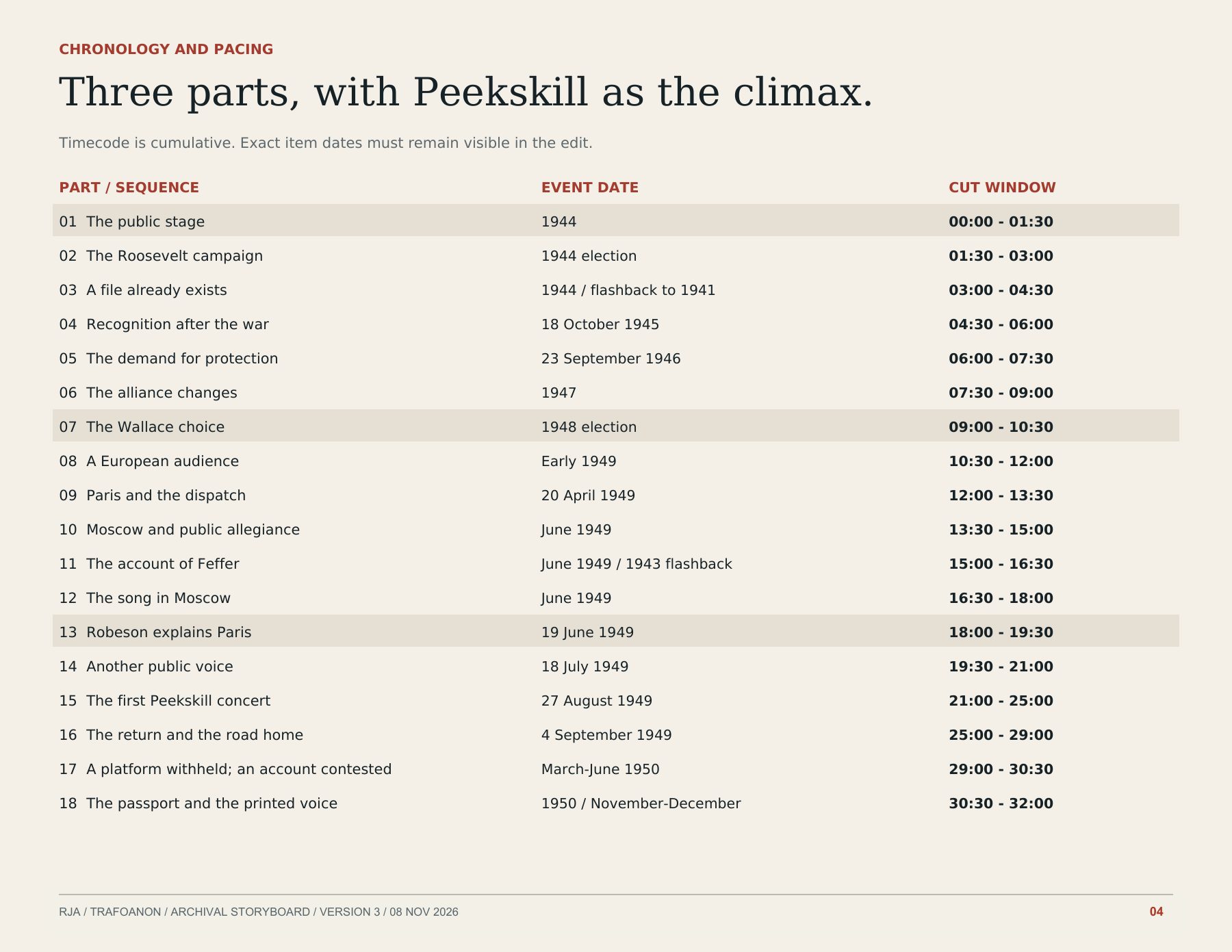 Enlarge this panel
Read page 4 text
CHRONOLOGY AND PACING
Three parts, with Peekskill as the climax.
Timecode is cumulative. Exact item dates must remain visible in the edit.
03
PART / SEQUENCE
EVENT DATE
CUT WINDOW
01 The public stage
1944
00:00 - 01:30
02 The Roosevelt campaign
1944 election
01:30 - 03:00
03 A file already exists
1944 / flashback to 1941
03:00 - 04:30
04 Recognition after the war
18 October 1945
04:30 - 06:00
05 The demand for protection
23 September 1946
06:00 - 07:30
06 The alliance changes
1947
07:30 - 09:00
07 The Wallace choice
1948 election
09:00 - 10:30
08 A European audience
Early 1949
10:30 - 12:00
09 Paris and the dispatch
20 April 1949
12:00 - 13:30
10 Moscow and public allegiance
June 1949
13:30 - 15:00
11 The account of Feffer
June 1949 / 1943 flashback
15:00 - 16:30
12 The song in Moscow
June 1949
16:30 - 18:00
13 Robeson explains Paris
19 June 1949
18:00 - 19:30
14 Another public voice
18 July 1949
19:30 - 21:00
15 The first Peekskill concert
27 August 1949
21:00 - 25:00
16 The return and the road home
4 September 1949
25:00 - 29:00
17 A platform withheld; an account contested
March-June 1950
29:00 - 30:30
18 The passport and the printed voice
1950 / November-December
30:30 - 32:00
04
05 / The public stage
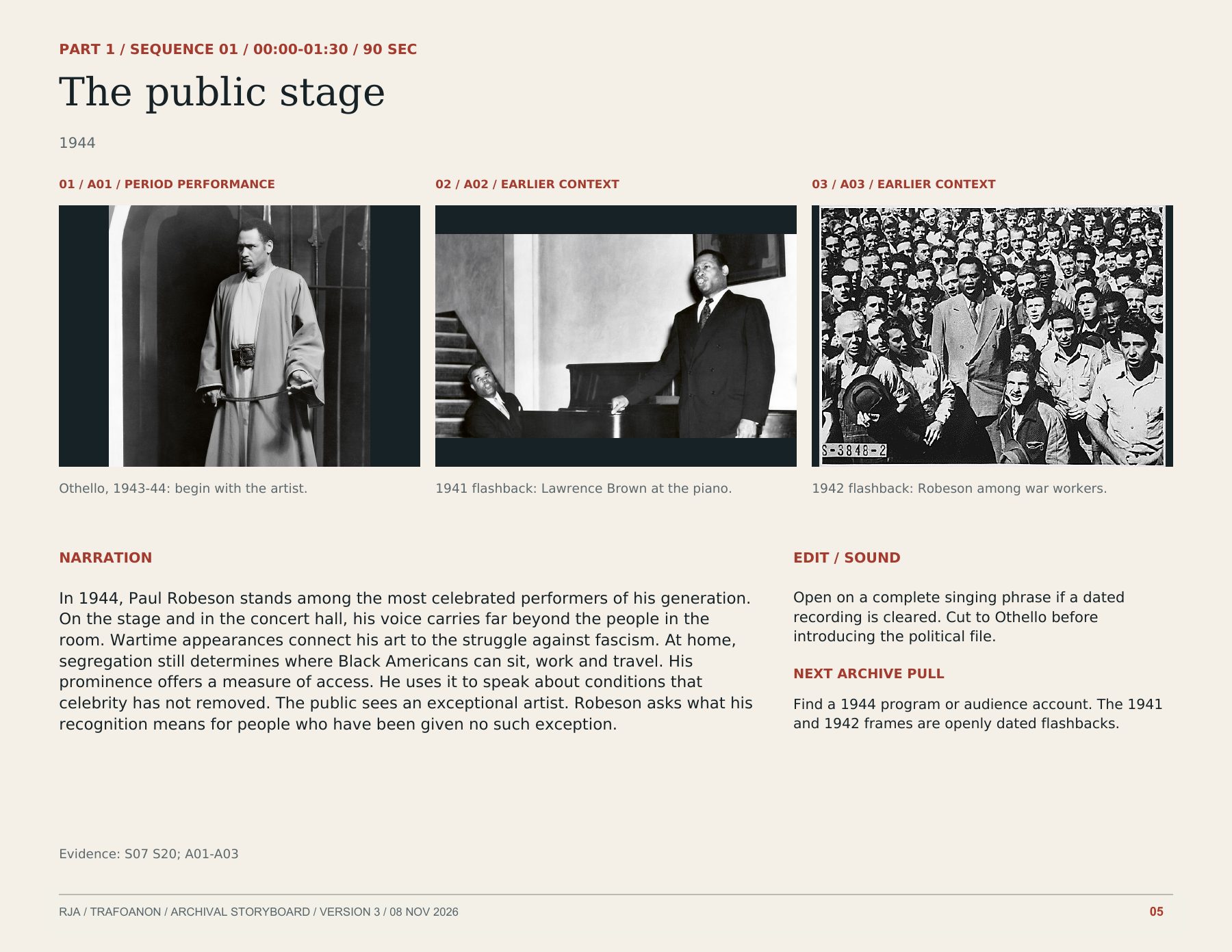 Enlarge this panel
Read page 5 text
PART 1 / SEQUENCE 01 / 00:00-01:30 / 90 SEC
The public stage
1944
04
01 / A01 / PERIOD PERFORMANCE
Othello, 1943-44: begin with the artist.
02 / A02 / EARLIER CONTEXT
1941 flashback: Lawrence Brown at the piano.
03 / A03 / EARLIER CONTEXT
1942 flashback: Robeson among war workers.
NARRATION
In 1944, Paul Robeson stands among the most celebrated performers of his generation.
On the stage and in the concert hall, his voice carries far beyond the people in the
room. Wartime appearances connect his art to the struggle against fascism. At home,
segregation still determines where Black Americans can sit, work and travel. His
prominence offers a measure of access. He uses it to speak about conditions that
celebrity has not removed. The public sees an exceptional artist. Robeson asks what his
recognition means for people who have been given no such exception.
EDIT / SOUND
Open on a complete singing phrase if a dated
recording is cleared. Cut to Othello before
introducing the political file.
NEXT ARCHIVE PULL
Find a 1944 program or audience account. The 1941
and 1942 frames are openly dated flashbacks.
Evidence: S07 S20; A01-A03
05
06 / The Roosevelt campaign
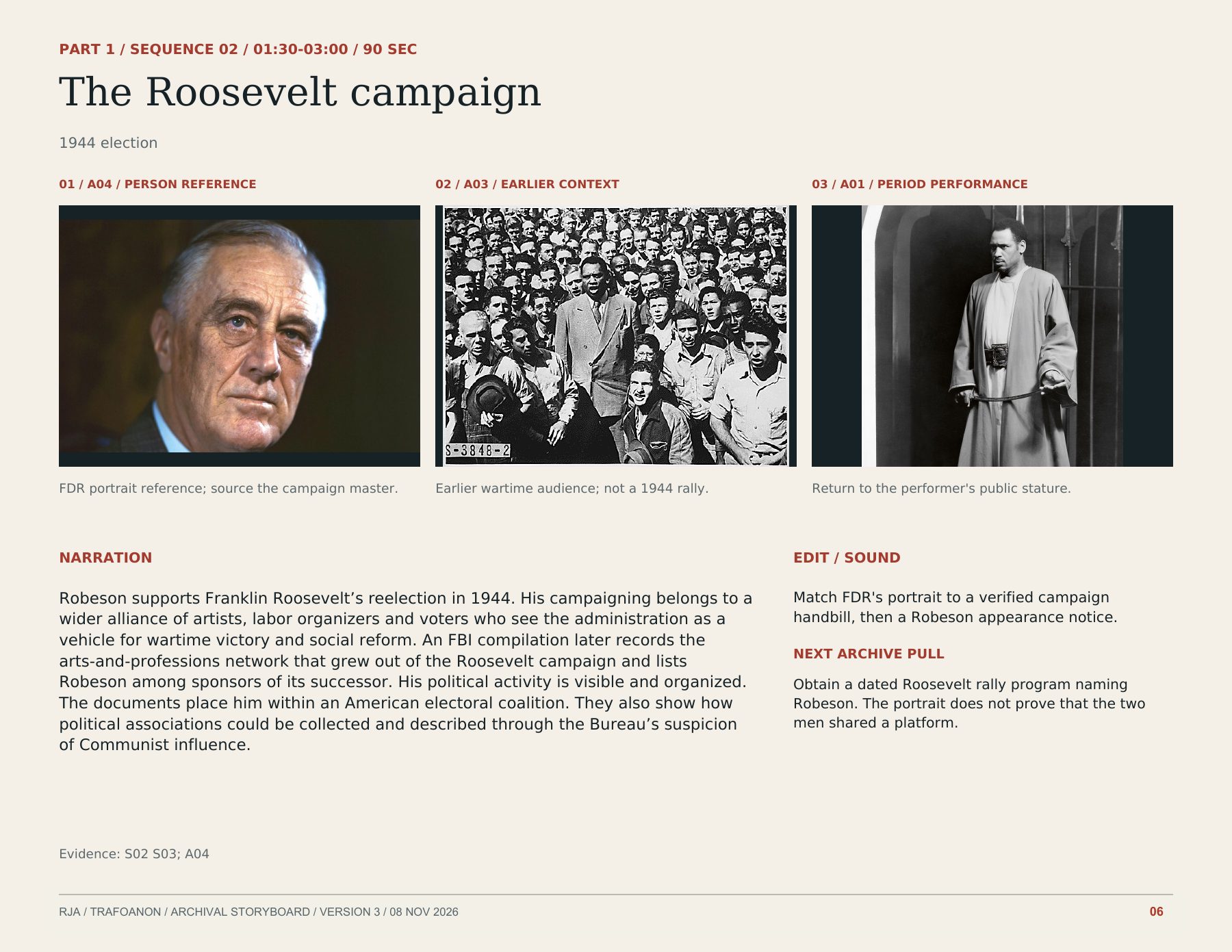 Enlarge this panel
Read page 6 text
PART 1 / SEQUENCE 02 / 01:30-03:00 / 90 SEC
The Roosevelt campaign
1944 election
05
01 / A04 / PERSON REFERENCE
FDR portrait reference; source the campaign master.
02 / A03 / EARLIER CONTEXT
Earlier wartime audience; not a 1944 rally.
03 / A01 / PERIOD PERFORMANCE
Return to the performer's public stature.
NARRATION
Robeson supports Franklin Roosevelt’s reelection in 1944. His campaigning belongs to a
wider alliance of artists, labor organizers and voters who see the administration as a
vehicle for wartime victory and social reform. An FBI compilation later records the
arts-and-professions network that grew out of the Roosevelt campaign and lists
Robeson among sponsors of its successor. His political activity is visible and organized.
The documents place him within an American electoral coalition. They also show how
political associations could be collected and described through the Bureau’s suspicion
of Communist influence.
EDIT / SOUND
Match FDR's portrait to a verified campaign
handbill, then a Robeson appearance notice.
NEXT ARCHIVE PULL
Obtain a dated Roosevelt rally program naming
Robeson. The portrait does not prove that the two
men shared a platform.
Evidence: S02 S03; A04
06
07 / A file already exists
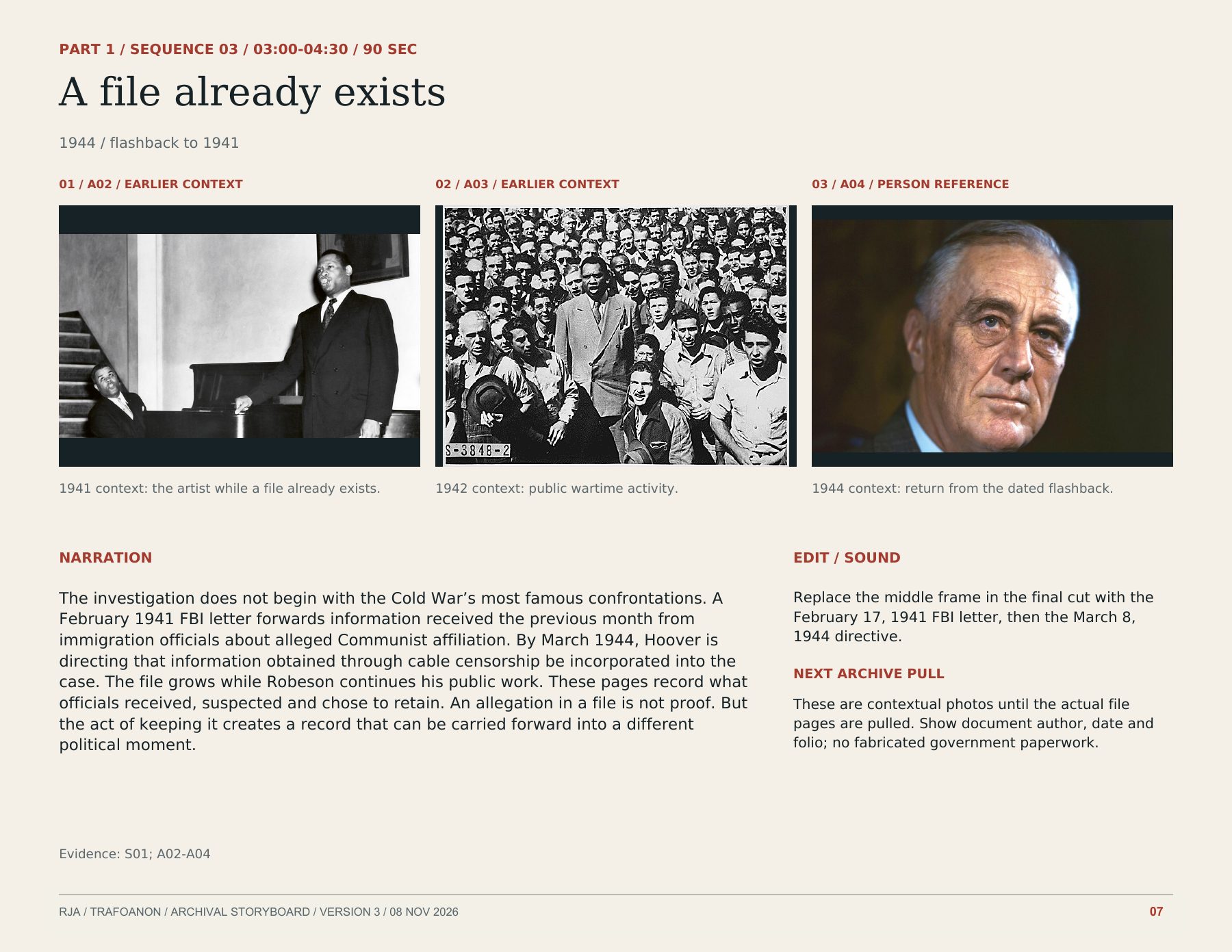 Enlarge this panel
Read page 7 text
PART 1 / SEQUENCE 03 / 03:00-04:30 / 90 SEC
A file already exists
1944 / flashback to 1941
06
01 / A02 / EARLIER CONTEXT
1941 context: the artist while a file already exists.
02 / A03 / EARLIER CONTEXT
1942 context: public wartime activity.
03 / A04 / PERSON REFERENCE
1944 context: return from the dated flashback.
NARRATION
The investigation does not begin with the Cold War’s most famous confrontations. A
February 1941 FBI letter forwards information received the previous month from
immigration officials about alleged Communist affiliation. By March 1944, Hoover is
directing that information obtained through cable censorship be incorporated into the
case. The file grows while Robeson continues his public work. These pages record what
officials received, suspected and chose to retain. An allegation in a file is not proof. But
the act of keeping it creates a record that can be carried forward into a different
political moment.
EDIT / SOUND
Replace the middle frame in the final cut with the
February 17, 1941 FBI letter, then the March 8,
1944 directive.
NEXT ARCHIVE PULL
These are contextual photos until the actual file
pages are pulled. Show document author, date and
folio; no fabricated government paperwork.
Evidence: S01; A02-A04
07
08 / Recognition after the war
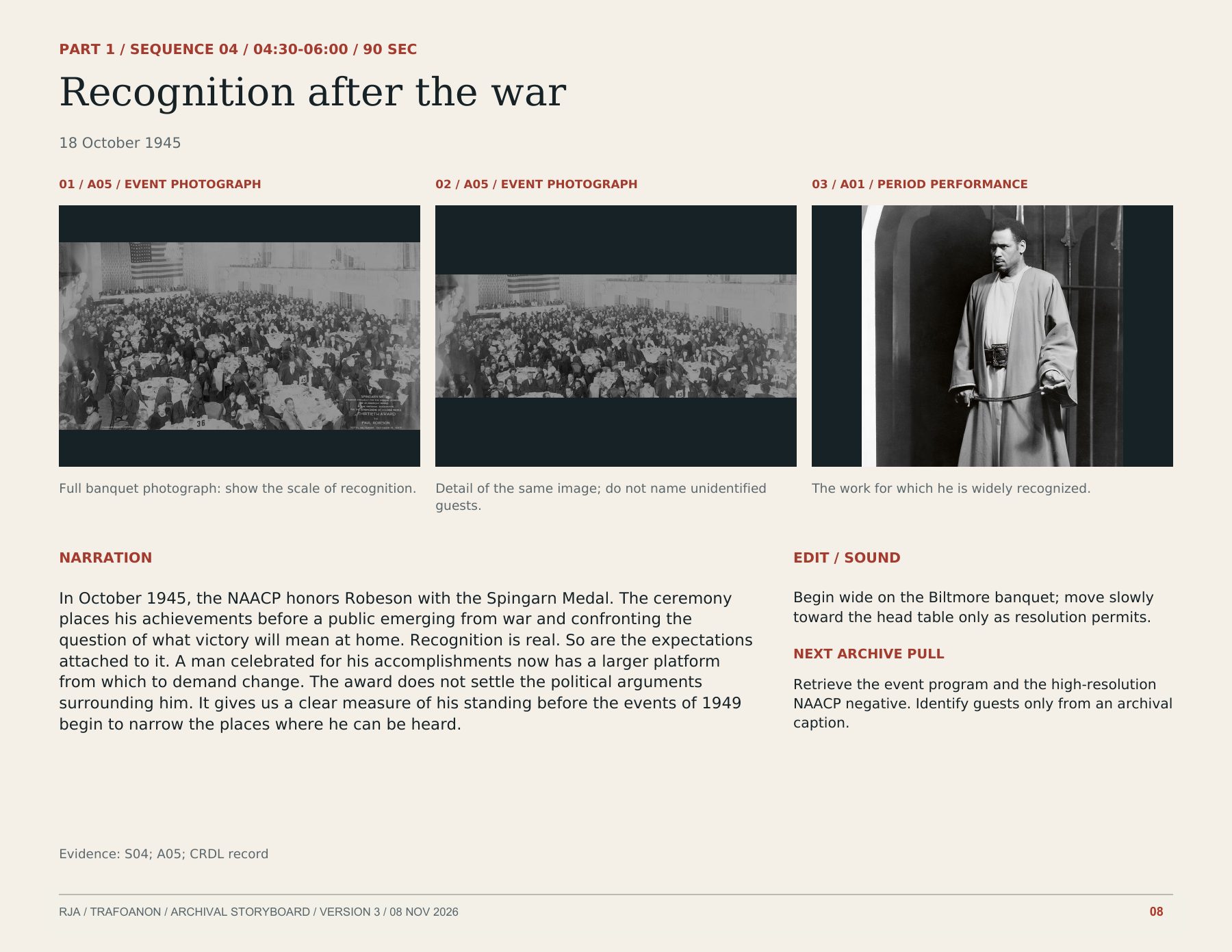 Enlarge this panel
Read page 8 text
PART 1 / SEQUENCE 04 / 04:30-06:00 / 90 SEC
Recognition after the war
18 October 1945
07
01 / A05 / EVENT PHOTOGRAPH
Full banquet photograph: show the scale of recognition.
02 / A05 / EVENT PHOTOGRAPH
Detail of the same image; do not name unidentified
guests.
03 / A01 / PERIOD PERFORMANCE
The work for which he is widely recognized.
NARRATION
In October 1945, the NAACP honors Robeson with the Spingarn Medal. The ceremony
places his achievements before a public emerging from war and confronting the
question of what victory will mean at home. Recognition is real. So are the expectations
attached to it. A man celebrated for his accomplishments now has a larger platform
from which to demand change. The award does not settle the political arguments
surrounding him. It gives us a clear measure of his standing before the events of 1949
begin to narrow the places where he can be heard.
EDIT / SOUND
Begin wide on the Biltmore banquet; move slowly
toward the head table only as resolution permits.
NEXT ARCHIVE PULL
Retrieve the event program and the high-resolution
NAACP negative. Identify guests only from an archival
caption.
Evidence: S04; A05; CRDL record
08
09 / The demand for protection
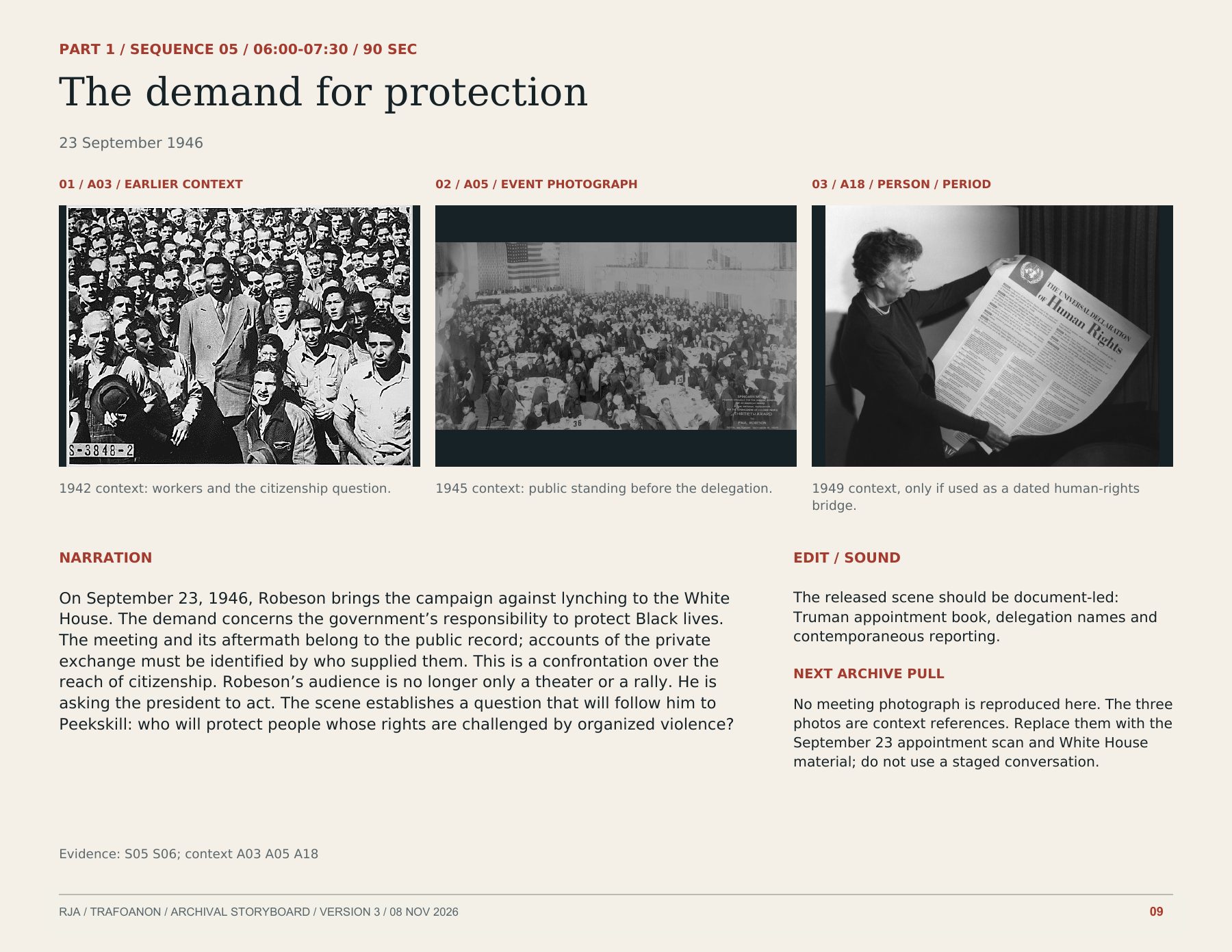 Enlarge this panel
Read page 9 text
PART 1 / SEQUENCE 05 / 06:00-07:30 / 90 SEC
The demand for protection
23 September 1946
08
01 / A03 / EARLIER CONTEXT
1942 context: workers and the citizenship question.
02 / A05 / EVENT PHOTOGRAPH
1945 context: public standing before the delegation.
03 / A18 / PERSON / PERIOD
1949 context, only if used as a dated human-rights
bridge.
NARRATION
On September 23, 1946, Robeson brings the campaign against lynching to the White
House. The demand concerns the government’s responsibility to protect Black lives.
The meeting and its aftermath belong to the public record; accounts of the private
exchange must be identified by who supplied them. This is a confrontation over the
reach of citizenship. Robeson’s audience is no longer only a theater or a rally. He is
asking the president to act. The scene establishes a question that will follow him to
Peekskill: who will protect people whose rights are challenged by organized violence?
EDIT / SOUND
The released scene should be document-led:
Truman appointment book, delegation names and
contemporaneous reporting.
NEXT ARCHIVE PULL
No meeting photograph is reproduced here. The three
photos are context references. Replace them with the
September 23 appointment scan and White House
material; do not use a staged conversation.
Evidence: S05 S06; context A03 A05 A18
09
10 / The alliance changes
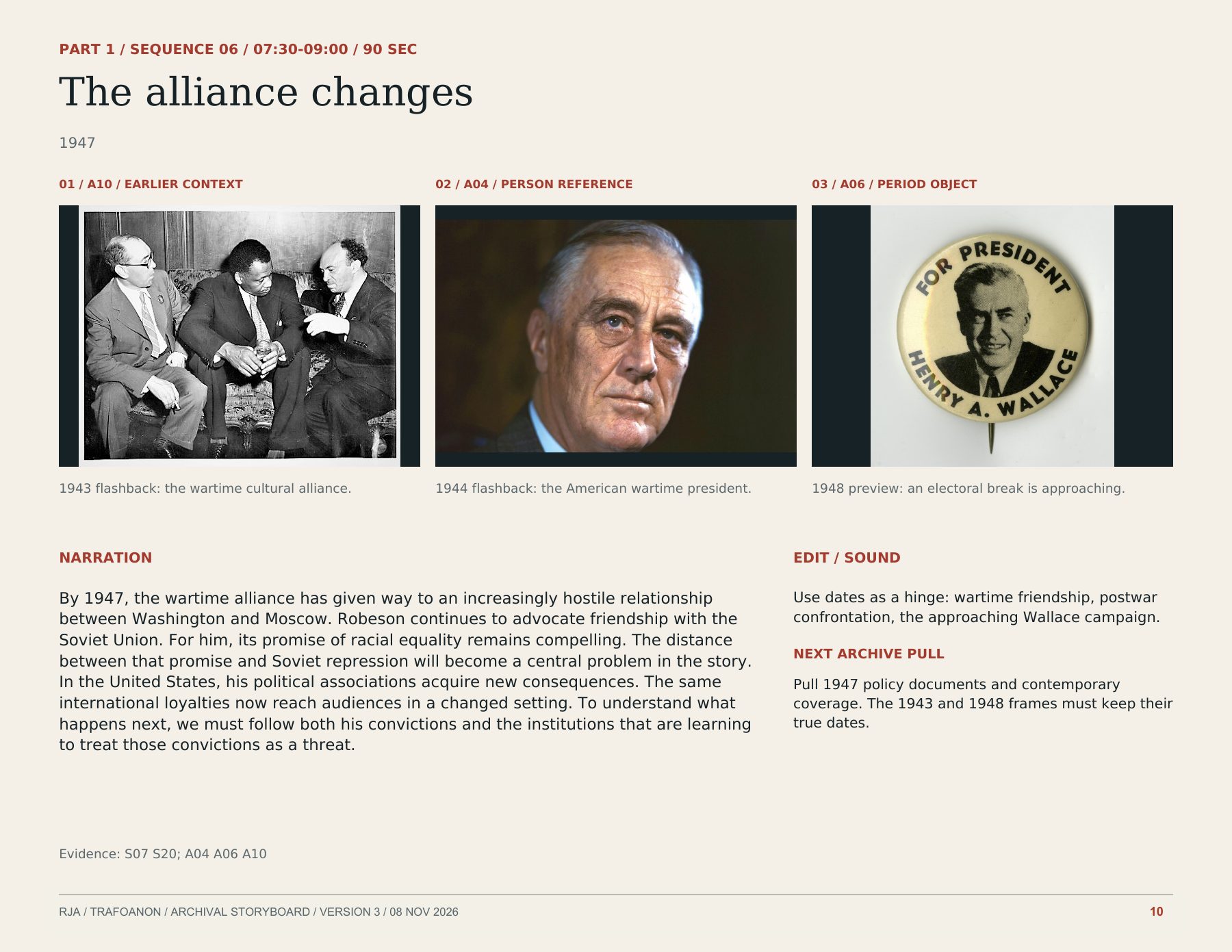 Enlarge this panel
Read page 10 text
PART 1 / SEQUENCE 06 / 07:30-09:00 / 90 SEC
The alliance changes
1947
09
01 / A10 / EARLIER CONTEXT
1943 flashback: the wartime cultural alliance.
02 / A04 / PERSON REFERENCE
1944 flashback: the American wartime president.
03 / A06 / PERIOD OBJECT
1948 preview: an electoral break is approaching.
NARRATION
By 1947, the wartime alliance has given way to an increasingly hostile relationship
between Washington and Moscow. Robeson continues to advocate friendship with the
Soviet Union. For him, its promise of racial equality remains compelling. The distance
between that promise and Soviet repression will become a central problem in the story.
In the United States, his political associations acquire new consequences. The same
international loyalties now reach audiences in a changed setting. To understand what
happens next, we must follow both his convictions and the institutions that are learning
to treat those convictions as a threat.
EDIT / SOUND
Use dates as a hinge: wartime friendship, postwar
confrontation, the approaching Wallace campaign.
NEXT ARCHIVE PULL
Pull 1947 policy documents and contemporary
coverage. The 1943 and 1948 frames must keep their
true dates.
Evidence: S07 S20; A04 A06 A10
10
11 / The Wallace choice
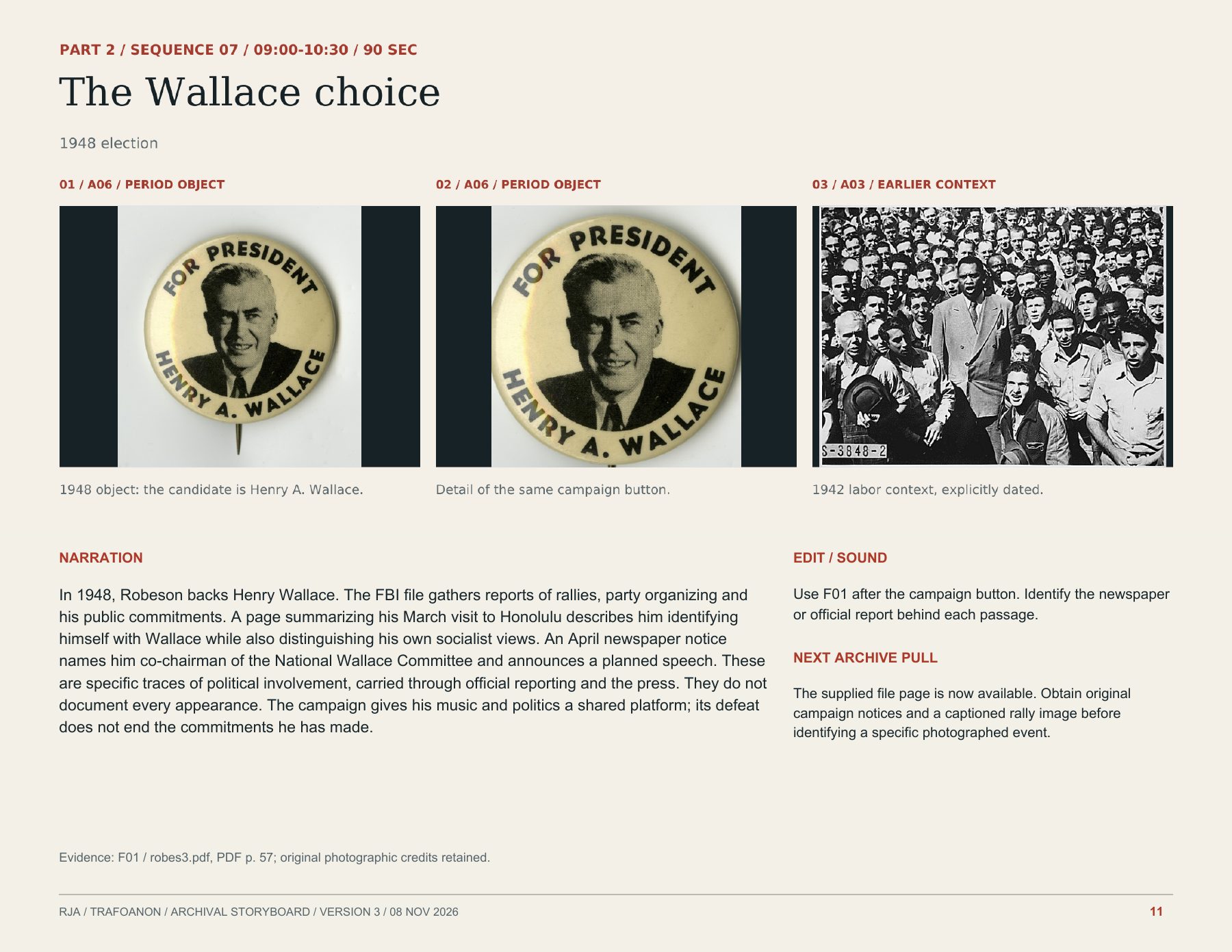 Enlarge this panel
Read page 11 text
PART 2 / SEQUENCE 07 / 09:00-10:30 / 90 SEC
The Wallace choice
1948 election
01 / A06 / PERIOD OBJECT
1948 object: the candidate is Henry A. Wallace.
02 / A06 / PERIOD OBJECT
Detail of the same campaign button.
03 / A03 / EARLIER CONTEXT
1942 labor context, explicitly dated.
NARRATION
In 1948, Robeson backs Henry Wallace. The FBI file gathers reports of rallies, party organizing and his public commitments. A page summarizing his March visit to Honolulu describes him identifying himself with Wallace while also distinguishing his own socialist views. An April newspaper notice names him co-chairman of the National Wallace Committee and announces a planned speech. These are specific traces of political involvement, carried through official reporting and the press. They do not document every appearance. The campaign gives his music and politics a shared platform; its defeat does not end the commitments he has made.
EDIT / SOUND
Use F01 after the campaign button. Identify the newspaper or official report behind each passage.
NEXT ARCHIVE PULL
The supplied file page is now available. Obtain original campaign notices and a captioned rally image before identifying a specific photographed event.
12 / F01 Wallace: a named political commitment
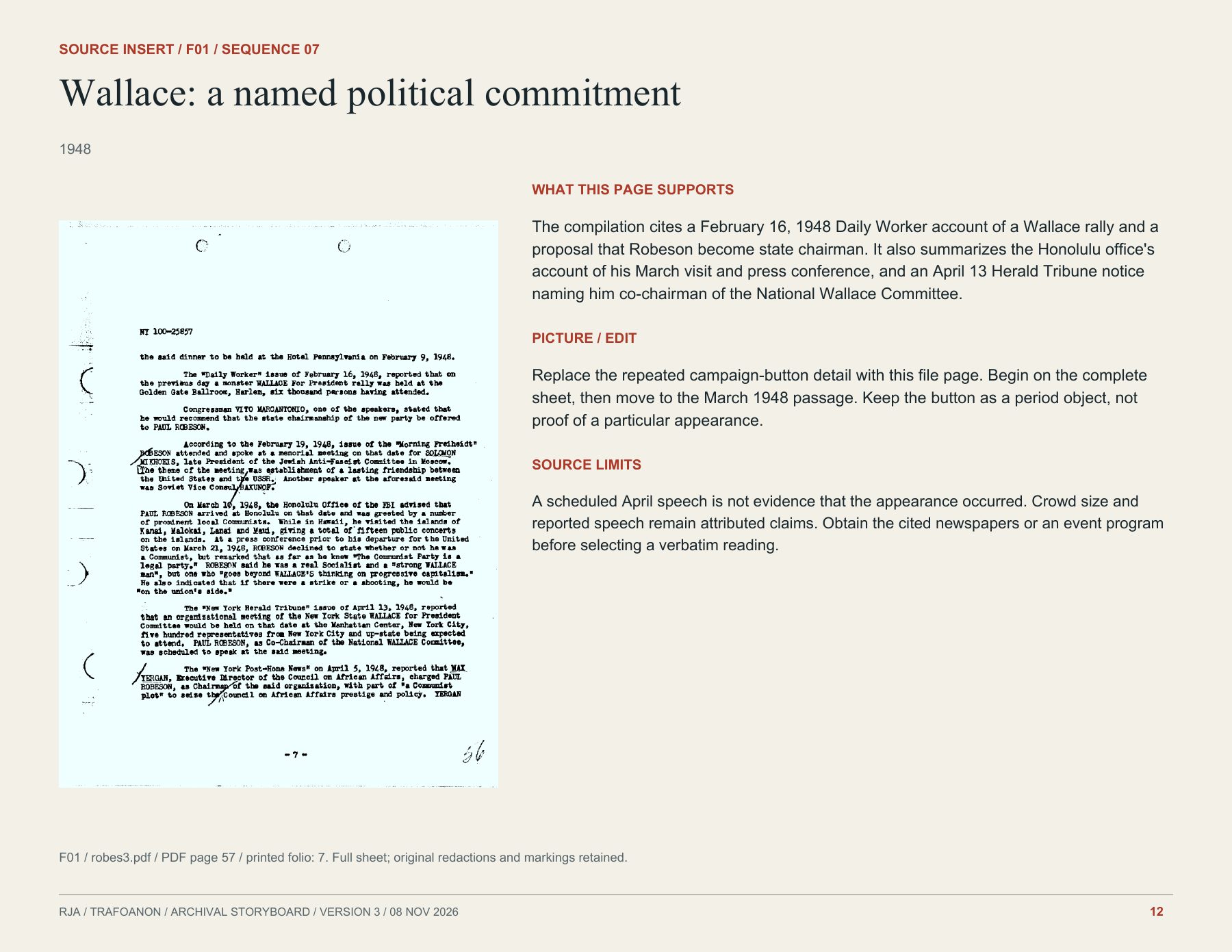 Enlarge this panel
Read page 12 text
SOURCE INSERT / F01 / SEQUENCE 07
Wallace: a named political commitment
1948
WHAT THIS PAGE SUPPORTS
The compilation cites a February 16, 1948 Daily Worker account of a Wallace rally and a
proposal that Robeson become state chairman. It also summarizes the Honolulu office's
account of his March visit and press conference, and an April 13 Herald Tribune notice
naming him co-chairman of the National Wallace Committee.
PICTURE / EDIT
Replace the repeated campaign-button detail with this file page. Begin on the complete
sheet, then move to the March 1948 passage. Keep the button as a period object, not
proof of a particular appearance.
SOURCE LIMITS
A scheduled April speech is not evidence that the appearance occurred. Crowd size and
reported speech remain attributed claims. Obtain the cited newspapers or an event program
before selecting a verbatim reading.
F01 / robes3.pdf / PDF page 57 / printed folio: 7. Full sheet; original redactions and markings retained.
12
13 / A European audience
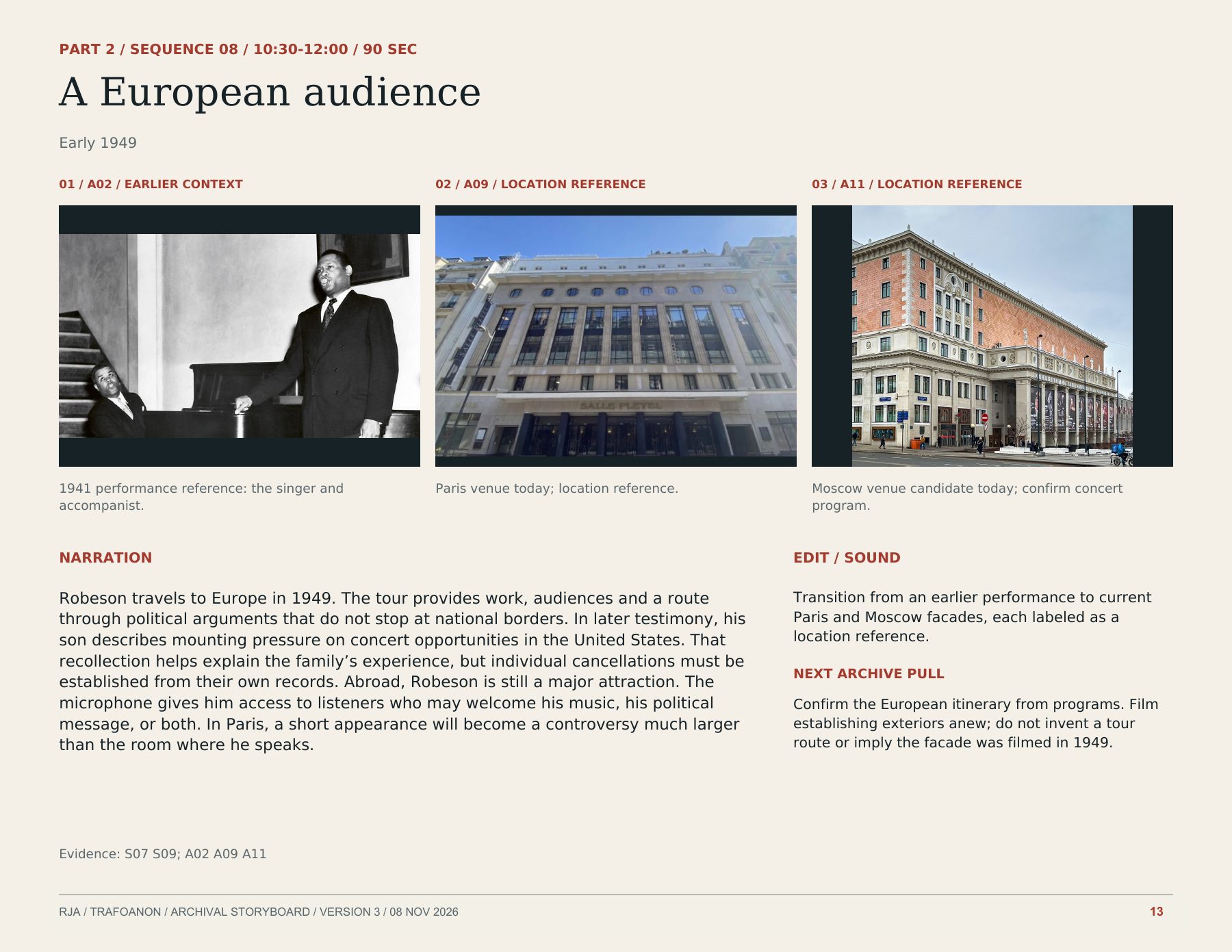 Enlarge this panel
Read page 13 text
PART 2 / SEQUENCE 08 / 10:30-12:00 / 90 SEC
A European audience
Early 1949
11
01 / A02 / EARLIER CONTEXT
1941 performance reference: the singer and
accompanist.
02 / A09 / LOCATION REFERENCE
Paris venue today; location reference.
03 / A11 / LOCATION REFERENCE
Moscow venue candidate today; confirm concert
program.
NARRATION
Robeson travels to Europe in 1949. The tour provides work, audiences and a route
through political arguments that do not stop at national borders. In later testimony, his
son describes mounting pressure on concert opportunities in the United States. That
recollection helps explain the family’s experience, but individual cancellations must be
established from their own records. Abroad, Robeson is still a major attraction. The
microphone gives him access to listeners who may welcome his music, his political
message, or both. In Paris, a short appearance will become a controversy much larger
than the room where he speaks.
EDIT / SOUND
Transition from an earlier performance to current
Paris and Moscow facades, each labeled as a
location reference.
NEXT ARCHIVE PULL
Confirm the European itinerary from programs. Film
establishing exteriors anew; do not invent a tour
route or imply the facade was filmed in 1949.
Evidence: S07 S09; A02 A09 A11
13
14 / Paris and the dispatch
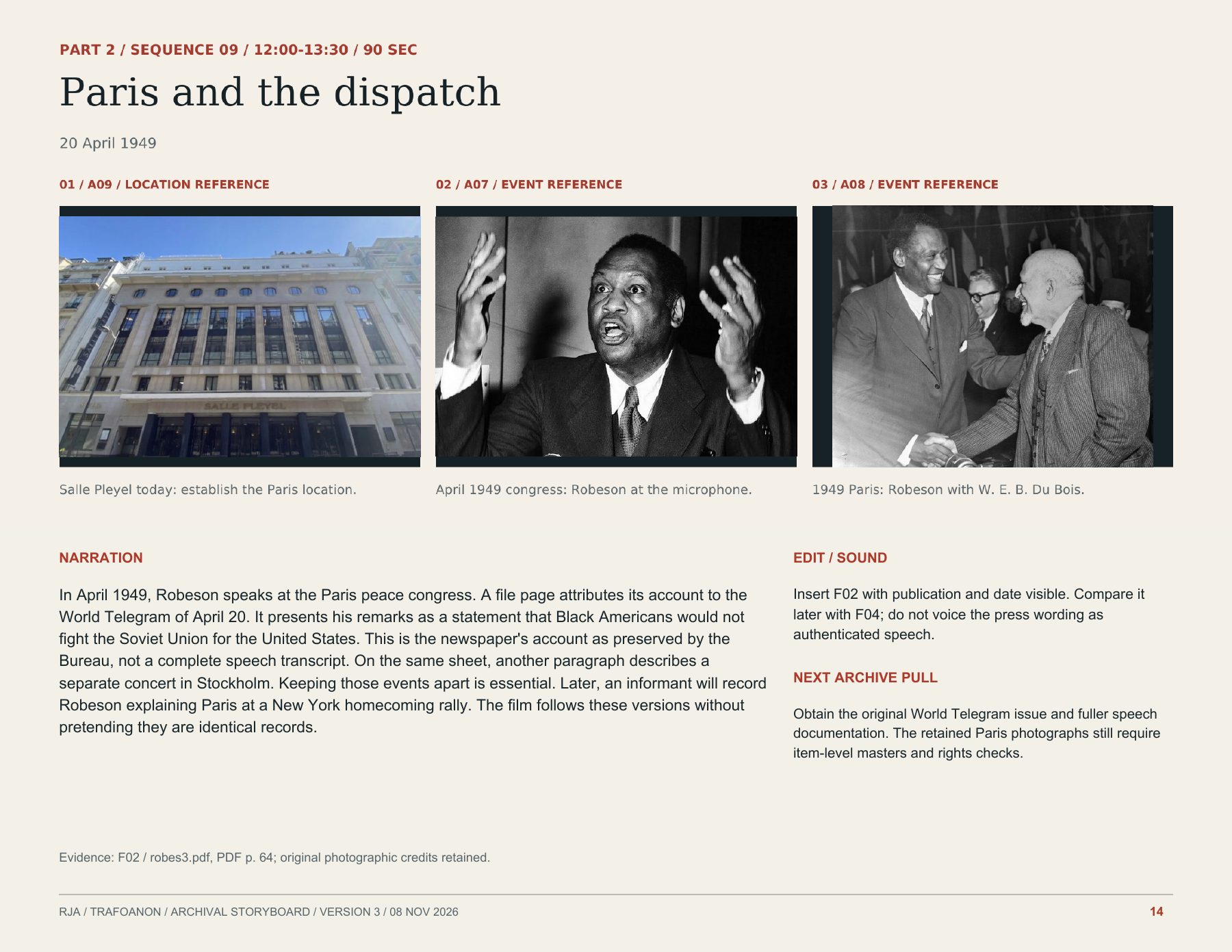 Enlarge this panel
Read page 14 text
PART 2 / SEQUENCE 09 / 12:00-13:30 / 90 SEC
Paris and the dispatch
20 April 1949
01 / A09 / LOCATION REFERENCE
Salle Pleyel today: establish the Paris location.
02 / A07 / EVENT REFERENCE
April 1949 congress: Robeson at the microphone.
03 / A08 / EVENT REFERENCE
1949 Paris: Robeson with W. E. B. Du Bois.
NARRATION
In April 1949, Robeson speaks at the Paris peace congress. A file page attributes its account to the World Telegram of April 20. It presents his remarks as a statement that Black Americans would not fight the Soviet Union for the United States. This is the newspaper's account as preserved by the Bureau, not a complete speech transcript. On the same sheet, another paragraph describes a separate concert in Stockholm. Keeping those events apart is essential. Later, an informant will record Robeson explaining Paris at a New York homecoming rally. The film follows these versions without pretending they are identical records.
EDIT / SOUND
Insert F02 with publication and date visible. Compare it later with F04; do not voice the press wording as authenticated speech.
NEXT ARCHIVE PULL
Obtain the original World Telegram issue and fuller speech documentation. The retained Paris photographs still require item-level masters and rights checks.
15 / F02 Paris: follow the words through the press
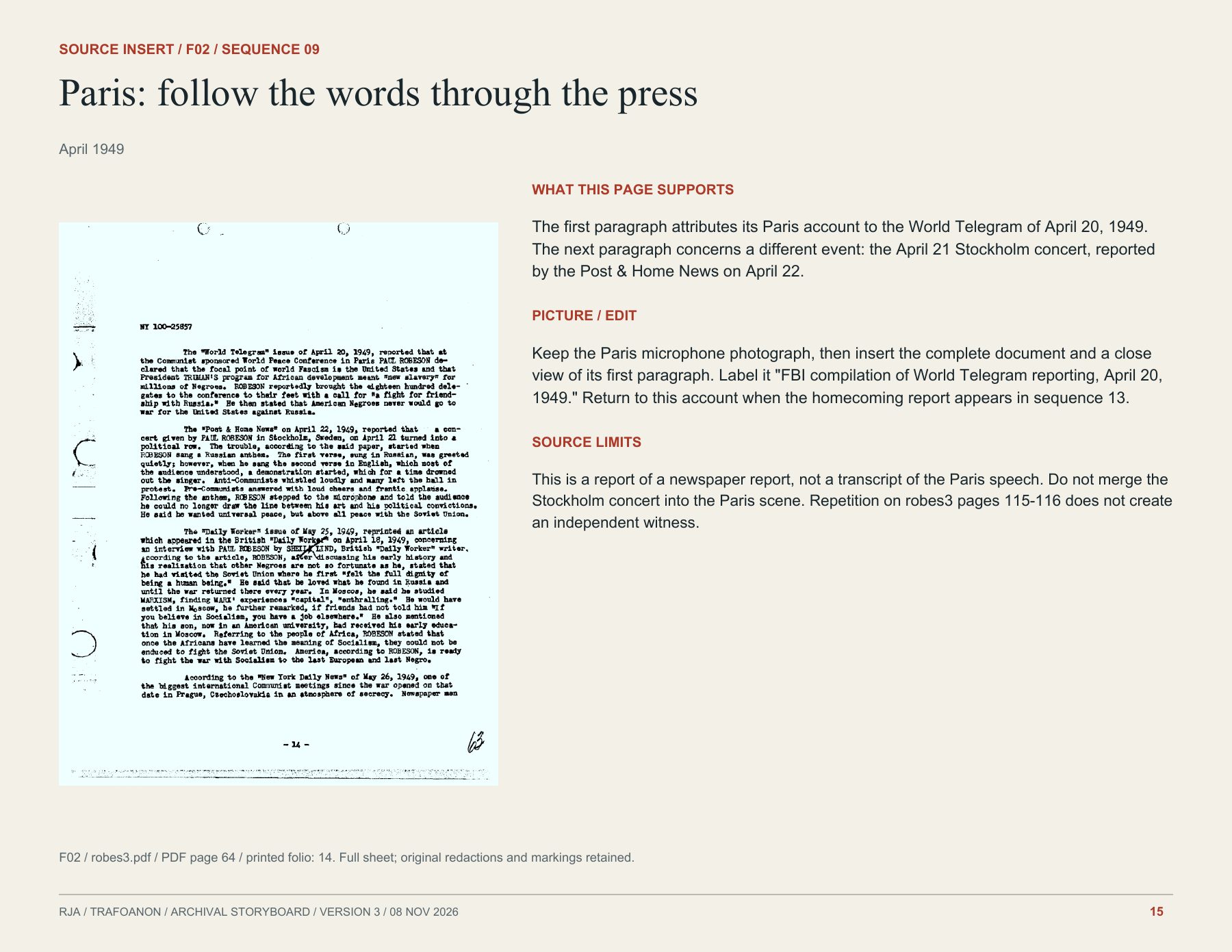 Enlarge this panel
Read page 15 text
SOURCE INSERT / F02 / SEQUENCE 09
Paris: follow the words through the press
April 1949
WHAT THIS PAGE SUPPORTS
The first paragraph attributes its Paris account to the World Telegram of April 20, 1949.
The next paragraph concerns a different event: the April 21 Stockholm concert, reported
by the Post & Home News on April 22.
PICTURE / EDIT
Keep the Paris microphone photograph, then insert the complete document and a close
view of its first paragraph. Label it "FBI compilation of World Telegram reporting, April 20,
1949." Return to this account when the homecoming report appears in sequence 13.
SOURCE LIMITS
This is a report of a newspaper report, not a transcript of the Paris speech. Do not merge the
Stockholm concert into the Paris scene. Repetition on robes3 pages 115-116 does not create
an independent witness.
F02 / robes3.pdf / PDF page 64 / printed folio: 14. Full sheet; original redactions and markings retained.
15
16 / Moscow and public allegiance
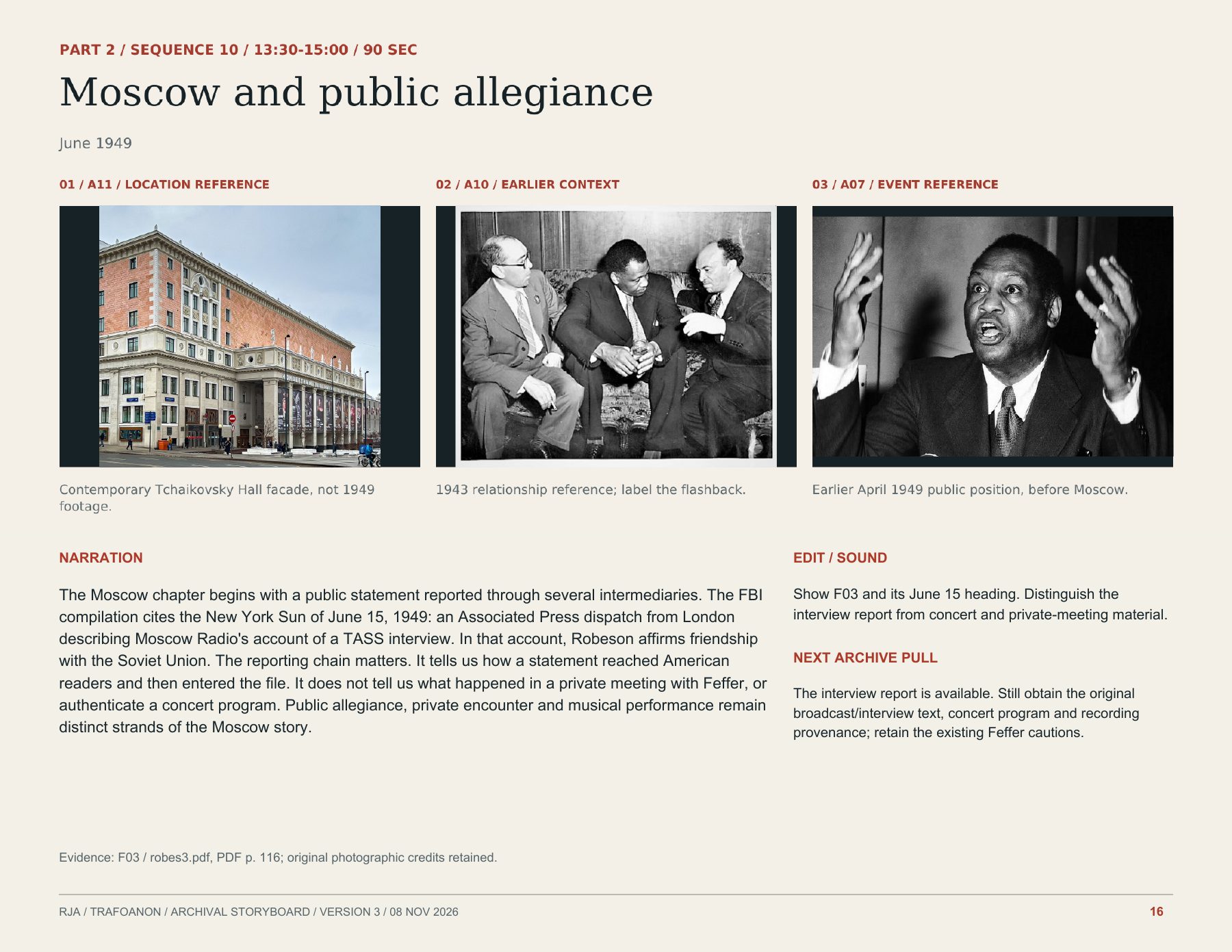 Enlarge this panel
Read page 16 text
PART 2 / SEQUENCE 10 / 13:30-15:00 / 90 SEC
Moscow and public allegiance
June 1949
01 / A11 / LOCATION REFERENCE
Contemporary Tchaikovsky Hall facade, not 1949
footage.
02 / A10 / EARLIER CONTEXT
1943 relationship reference; label the flashback.
03 / A07 / EVENT REFERENCE
Earlier April 1949 public position, before Moscow.
NARRATION
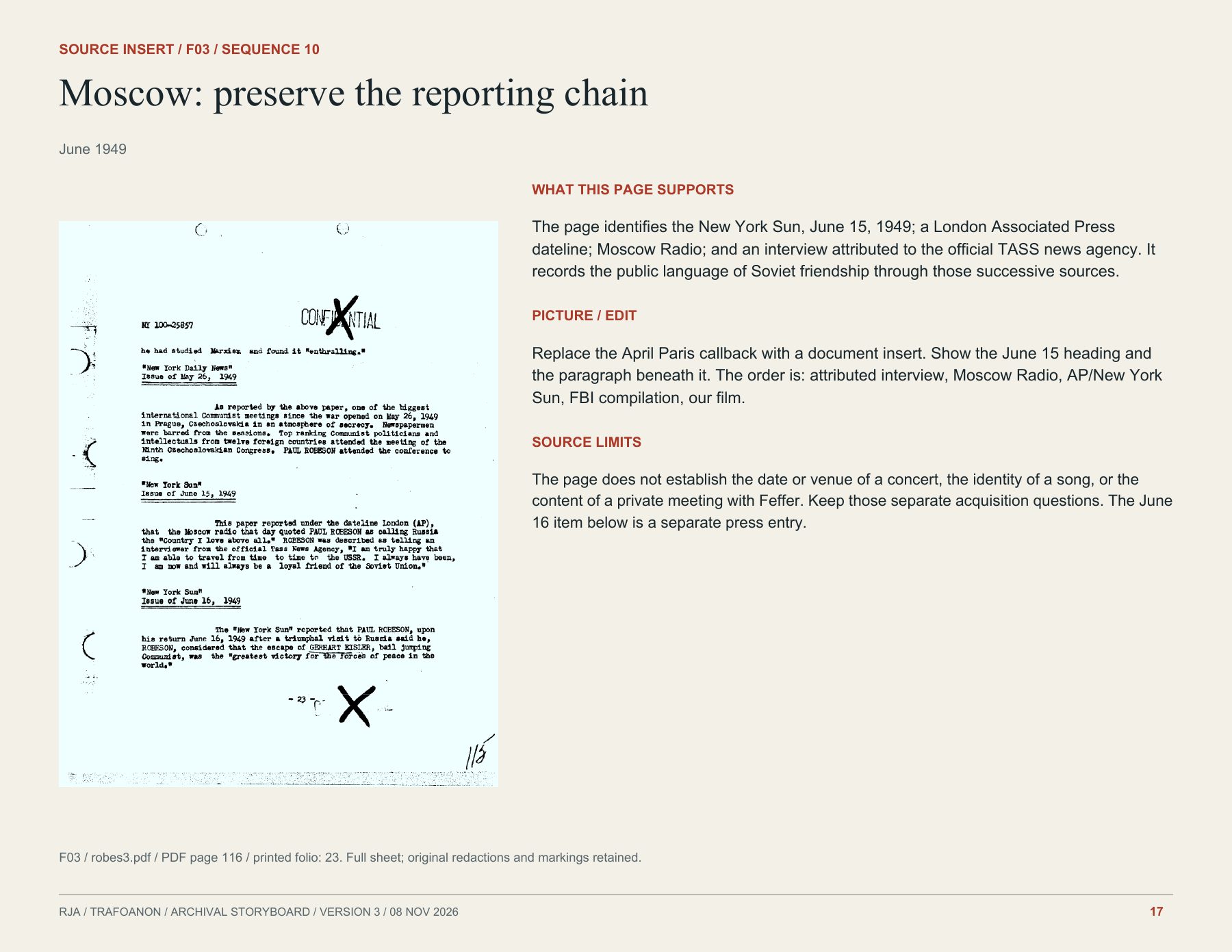
The Moscow chapter begins with a public statement reported through several intermediaries. The FBI compilation cites the New York Sun of June 15, 1949: an Associated Press dispatch from London describing Moscow Radio's account of a TASS interview. In that account, Robeson affirms friendship with the Soviet Union. The reporting chain matters. It tells us how a statement reached American readers and then entered the file. It does not tell us what happened in a private meeting with Feffer, or authenticate a concert program. Public allegiance, private encounter and musical performance remain distinct strands of the Moscow story.
EDIT / SOUND
Show F03 and its June 15 heading. Distinguish the interview report from concert and private-meeting material.
NEXT ARCHIVE PULL
The interview report is available. Still obtain the original broadcast/interview text, concert program and recording provenance; retain the existing Feffer cautions.
17 / F03 Moscow: preserve the reporting chain
 Enlarge this panel
Read page 17 text
SOURCE INSERT / F03 / SEQUENCE 10
Moscow: preserve the reporting chain
June 1949
WHAT THIS PAGE SUPPORTS
The page identifies the New York Sun, June 15, 1949; a London Associated Press
dateline; Moscow Radio; and an interview attributed to the official TASS news agency. It
records the public language of Soviet friendship through those successive sources.
PICTURE / EDIT
Replace the April Paris callback with a document insert. Show the June 15 heading and
the paragraph beneath it. The order is: attributed interview, Moscow Radio, AP/New York
Sun, FBI compilation, our film.
SOURCE LIMITS
The page does not establish the date or venue of a concert, the identity of a song, or the
content of a private meeting with Feffer. Keep those separate acquisition questions. The June
16 item below is a separate press entry.
F03 / robes3.pdf / PDF page 116 / printed folio: 23. Full sheet; original redactions and markings retained.
17
18 / The account of Feffer
 Enlarge this panel
Read page 18 text
PART 2 / SEQUENCE 11 / 15:00-16:30 / 90 SEC
The account of Feffer
June 1949 / 1943 flashback
14
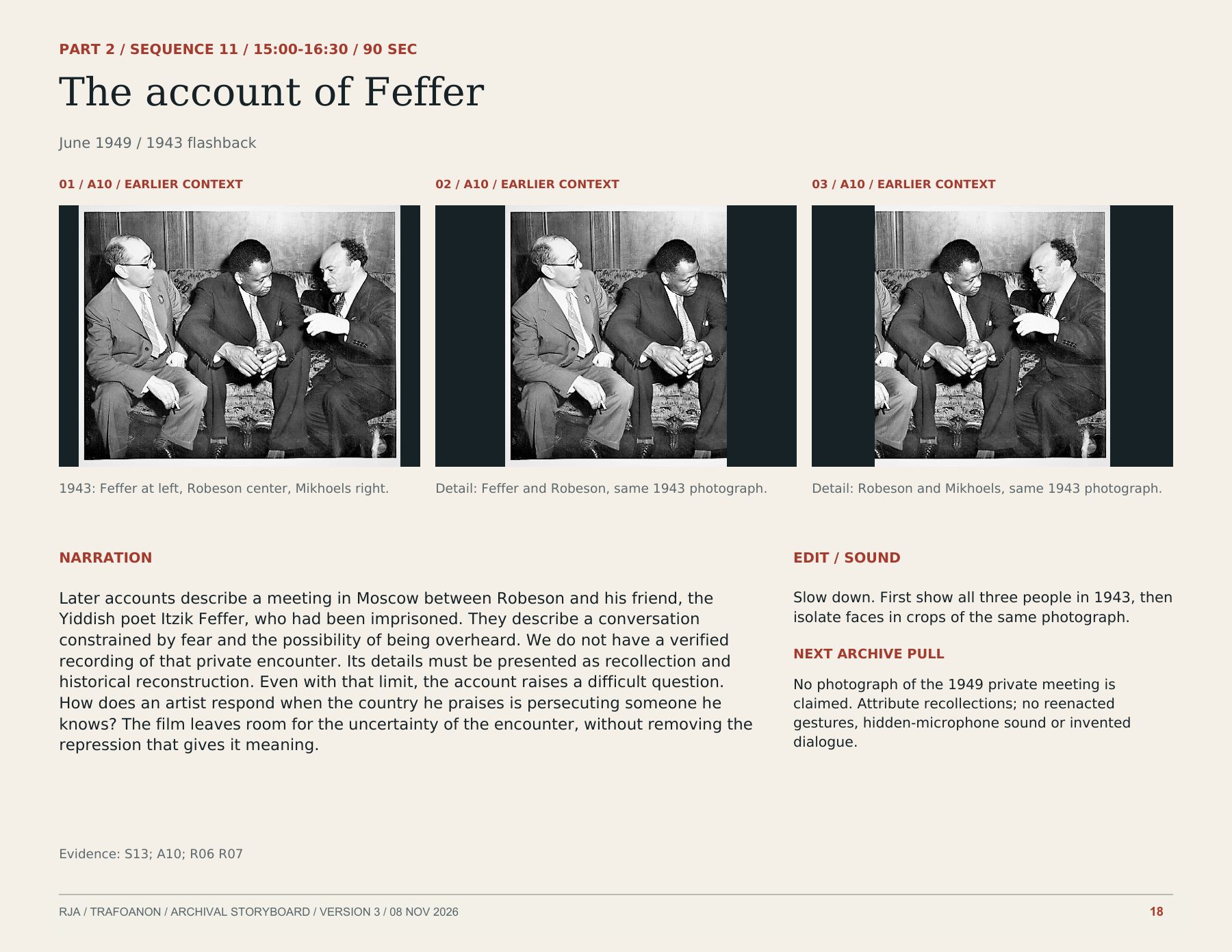
01 / A10 / EARLIER CONTEXT
1943: Feffer at left, Robeson center, Mikhoels right.
02 / A10 / EARLIER CONTEXT
Detail: Feffer and Robeson, same 1943 photograph.
03 / A10 / EARLIER CONTEXT
Detail: Robeson and Mikhoels, same 1943 photograph.
NARRATION
Later accounts describe a meeting in Moscow between Robeson and his friend, the
Yiddish poet Itzik Feffer, who had been imprisoned. They describe a conversation
constrained by fear and the possibility of being overheard. We do not have a verified
recording of that private encounter. Its details must be presented as recollection and
historical reconstruction. Even with that limit, the account raises a difficult question.
How does an artist respond when the country he praises is persecuting someone he
knows? The film leaves room for the uncertainty of the encounter, without removing the
repression that gives it meaning.
EDIT / SOUND
Slow down. First show all three people in 1943, then
isolate faces in crops of the same photograph.
NEXT ARCHIVE PULL
No photograph of the 1949 private meeting is
claimed. Attribute recollections; no reenacted
gestures, hidden-microphone sound or invented
dialogue.
Evidence: S13; A10; R06 R07
18
19 / The song in Moscow
 Enlarge this panel
Read page 19 text
PART 2 / SEQUENCE 12 / 16:30-18:00 / 90 SEC
The song in Moscow
June 1949
15
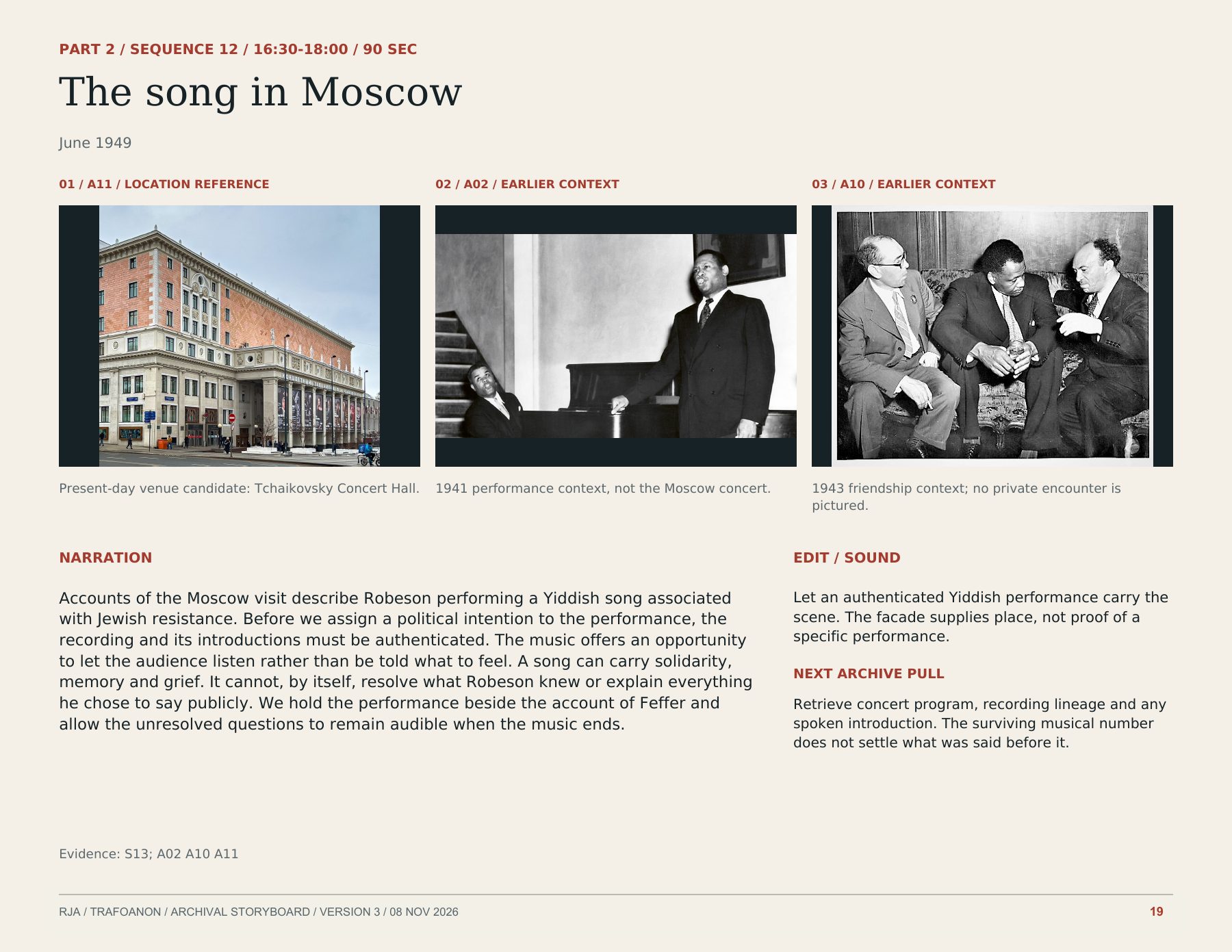
01 / A11 / LOCATION REFERENCE
Present-day venue candidate: Tchaikovsky Concert Hall.
02 / A02 / EARLIER CONTEXT
1941 performance context, not the Moscow concert.
03 / A10 / EARLIER CONTEXT
1943 friendship context; no private encounter is
pictured.
NARRATION
Accounts of the Moscow visit describe Robeson performing a Yiddish song associated
with Jewish resistance. Before we assign a political intention to the performance, the
recording and its introductions must be authenticated. The music offers an opportunity
to let the audience listen rather than be told what to feel. A song can carry solidarity,
memory and grief. It cannot, by itself, resolve what Robeson knew or explain everything
he chose to say publicly. We hold the performance beside the account of Feffer and
allow the unresolved questions to remain audible when the music ends.
EDIT / SOUND
Let an authenticated Yiddish performance carry the
scene. The facade supplies place, not proof of a
specific performance.
NEXT ARCHIVE PULL
Retrieve concert program, recording lineage and any
spoken introduction. The surviving musical number
does not settle what was said before it.
Evidence: S13; A02 A10 A11
19
20 / Robeson explains Paris
 Enlarge this panel
Read page 20 text
PART 3 / SEQUENCE 13 / 18:00-19:30 / 90 SEC
Robeson explains Paris
19 June 1949
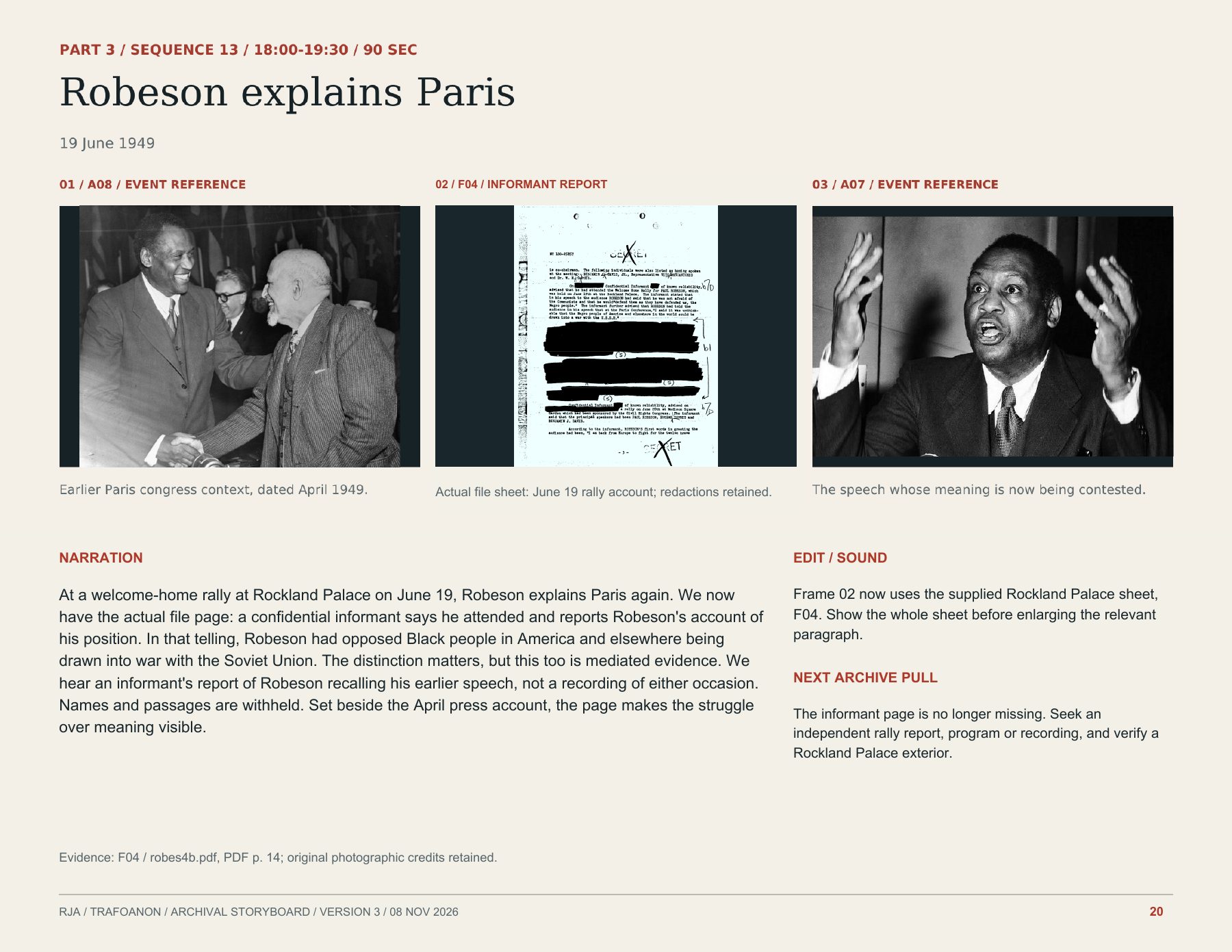
01 / A08 / EVENT REFERENCE
Earlier Paris congress context, dated April 1949.
02 / F04 / INFORMANT REPORT
Actual file sheet: June 19 rally account; redactions retained.
03 / A07 / EVENT REFERENCE
The speech whose meaning is now being contested.
NARRATION
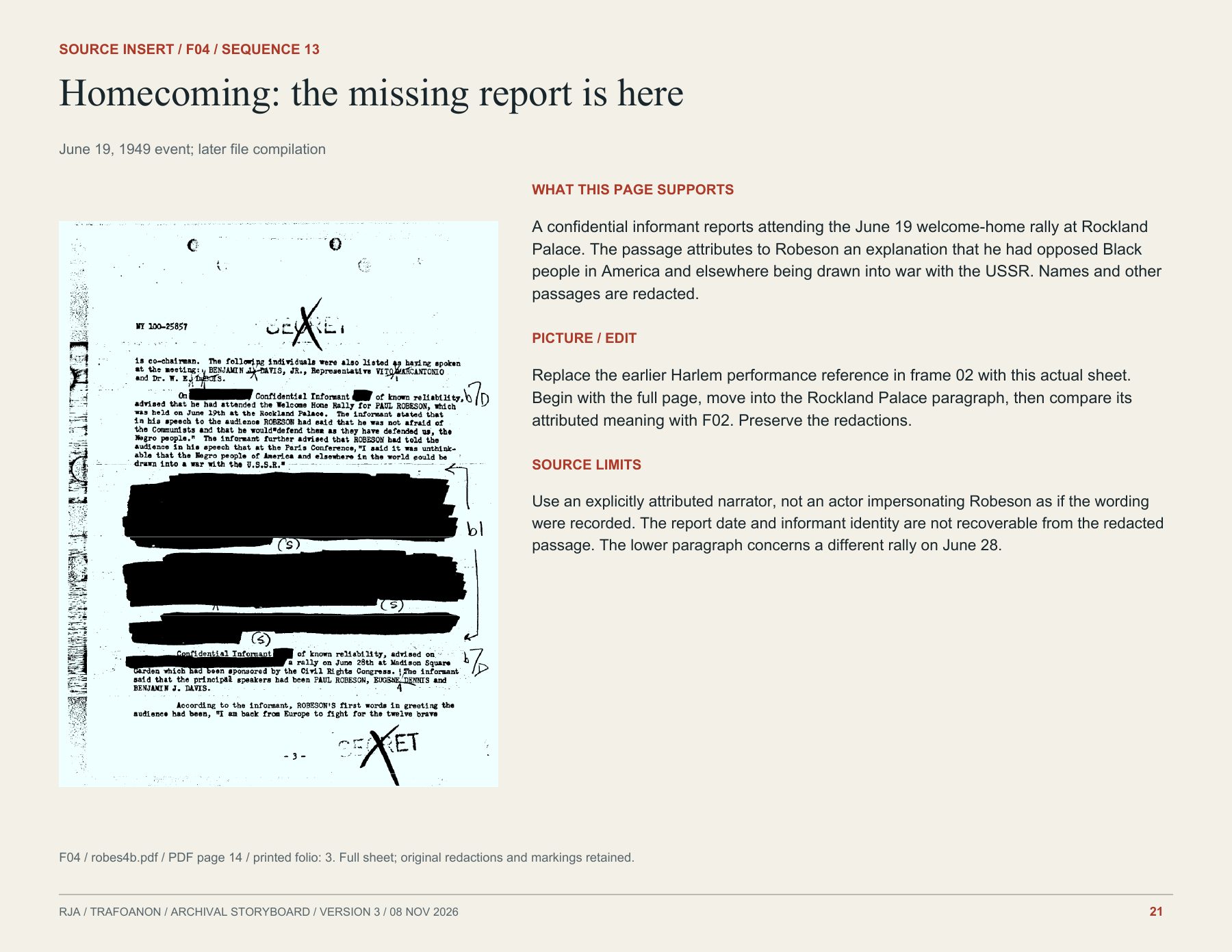
At a welcome-home rally at Rockland Palace on June 19, Robeson explains Paris again. We now have the actual file page: a confidential informant says he attended and reports Robeson's account of his position. In that telling, Robeson had opposed Black people in America and elsewhere being drawn into war with the Soviet Union. The distinction matters, but this too is mediated evidence. We hear an informant's report of Robeson recalling his earlier speech, not a recording of either occasion. Names and passages are withheld. Set beside the April press account, the page makes the struggle over meaning visible.
EDIT / SOUND
Frame 02 now uses the supplied Rockland Palace sheet, F04. Show the whole sheet before enlarging the relevant paragraph.
NEXT ARCHIVE PULL
The informant page is no longer missing. Seek an independent rally report, program or recording, and verify a Rockland Palace exterior.
21 / F04 Homecoming: the missing report is here
 Enlarge this panel
Read page 21 text
SOURCE INSERT / F04 / SEQUENCE 13
Homecoming: the missing report is here
June 19, 1949 event; later file compilation
WHAT THIS PAGE SUPPORTS
A confidential informant reports attending the June 19 welcome-home rally at Rockland
Palace. The passage attributes to Robeson an explanation that he had opposed Black
people in America and elsewhere being drawn into war with the USSR. Names and other
passages are redacted.
PICTURE / EDIT
Replace the earlier Harlem performance reference in frame 02 with this actual sheet.
Begin with the full page, move into the Rockland Palace paragraph, then compare its
attributed meaning with F02. Preserve the redactions.
SOURCE LIMITS
Use an explicitly attributed narrator, not an actor impersonating Robeson as if the wording
were recorded. The report date and informant identity are not recoverable from the redacted
passage. The lower paragraph concerns a different rally on June 28.
F04 / robes4b.pdf / PDF page 14 / printed folio: 3. Full sheet; original redactions and markings retained.
21
22 / Another public voice
 Enlarge this panel
Read page 22 text
PART 3 / SEQUENCE 14 / 19:30-21:00 / 90 SEC
Another public voice
18 July 1949
17
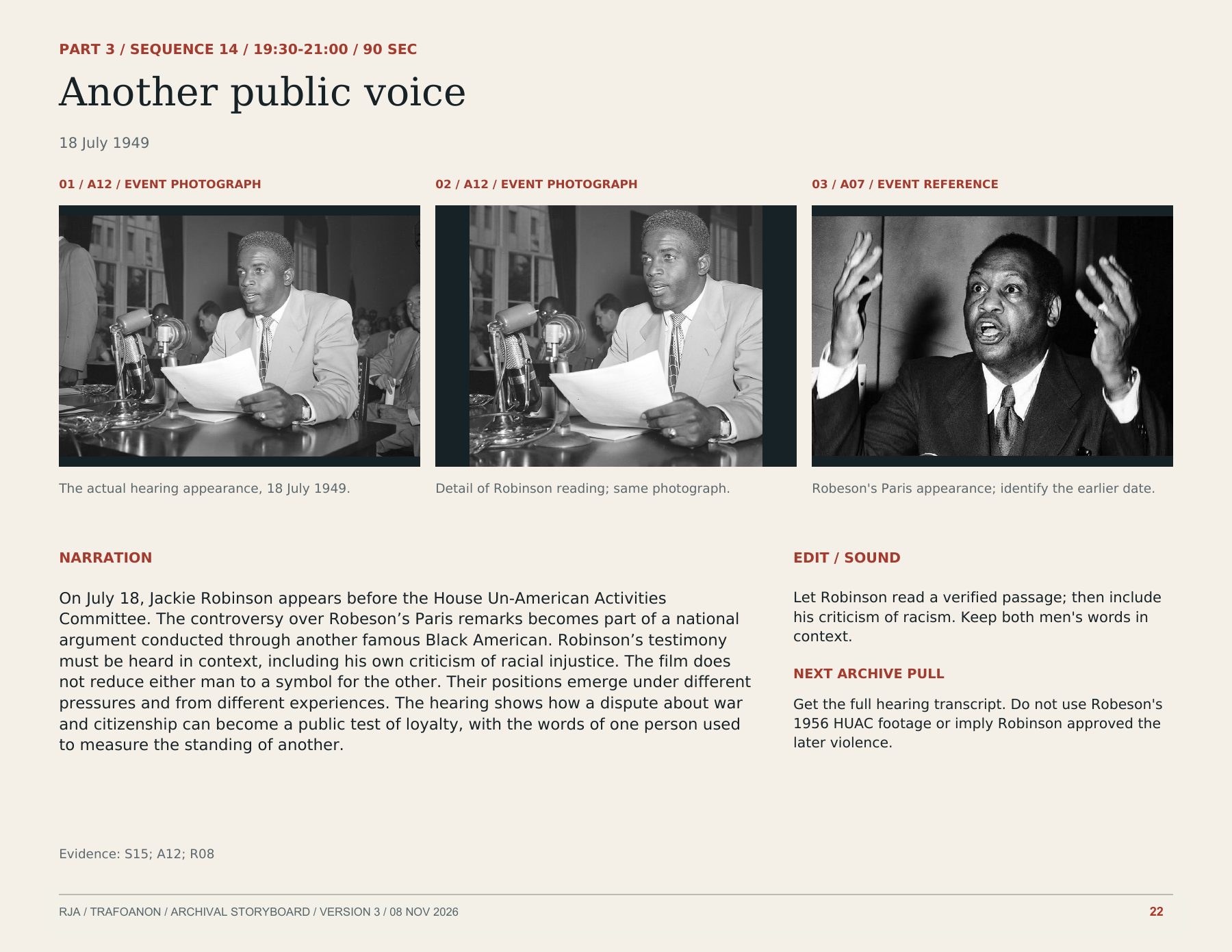
01 / A12 / EVENT PHOTOGRAPH
The actual hearing appearance, 18 July 1949.
02 / A12 / EVENT PHOTOGRAPH
Detail of Robinson reading; same photograph.
03 / A07 / EVENT REFERENCE
Robeson's Paris appearance; identify the earlier date.
NARRATION
On July 18, Jackie Robinson appears before the House Un-American Activities
Committee. The controversy over Robeson’s Paris remarks becomes part of a national
argument conducted through another famous Black American. Robinson’s testimony
must be heard in context, including his own criticism of racial injustice. The film does
not reduce either man to a symbol for the other. Their positions emerge under different
pressures and from different experiences. The hearing shows how a dispute about war
and citizenship can become a public test of loyalty, with the words of one person used
to measure the standing of another.
EDIT / SOUND
Let Robinson read a verified passage; then include
his criticism of racism. Keep both men's words in
context.
NEXT ARCHIVE PULL
Get the full hearing transcript. Do not use Robeson's
1956 HUAC footage or imply Robinson approved the
later violence.
Evidence: S15; A12; R08
22
23 / The first Peekskill concert
 Enlarge this panel
Read page 23 text
PART 3 / SEQUENCE 15 / 21:00-25:00 / 240 SEC
The first Peekskill concert
27 August 1949
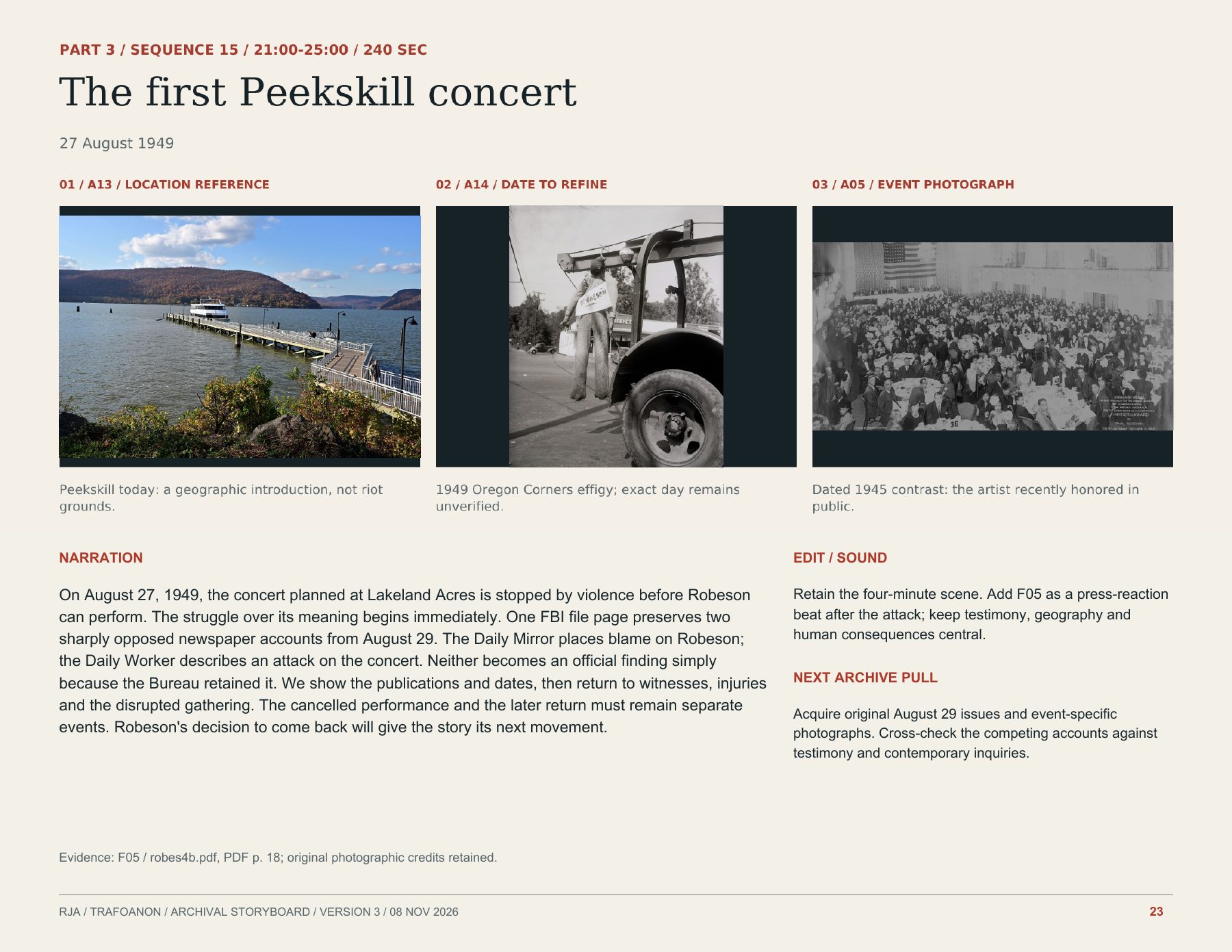
01 / A13 / LOCATION REFERENCE
Peekskill today: a geographic introduction, not riot
grounds.
02 / A14 / DATE TO REFINE
1949 Oregon Corners effigy; exact day remains
unverified.
03 / A05 / EVENT PHOTOGRAPH
Dated 1945 contrast: the artist recently honored in
public.
NARRATION
On August 27, 1949, the concert planned at Lakeland Acres is stopped by violence before Robeson can perform. The struggle over its meaning begins immediately. One FBI file page preserves two sharply opposed newspaper accounts from August 29. The Daily Mirror places blame on Robeson; the Daily Worker describes an attack on the concert. Neither becomes an official finding simply because the Bureau retained it. We show the publications and dates, then return to witnesses, injuries and the disrupted gathering. The cancelled performance and the later return must remain separate events. Robeson's decision to come back will give the story its next movement.
EDIT / SOUND
Retain the four-minute scene. Add F05 as a press-reaction beat after the attack; keep testimony, geography and human consequences central.
NEXT ARCHIVE PULL
Acquire original August 29 issues and event-specific photographs. Cross-check the competing accounts against testimony and contemporary inquiries.
24 / F05 Peekskill: competing accounts on one sheet
 Enlarge this panel
Read page 24 text
SOURCE INSERT / F05 / SEQUENCE 15
Peekskill: competing accounts on one sheet
August 27 event; August 29-31, 1949 reporting
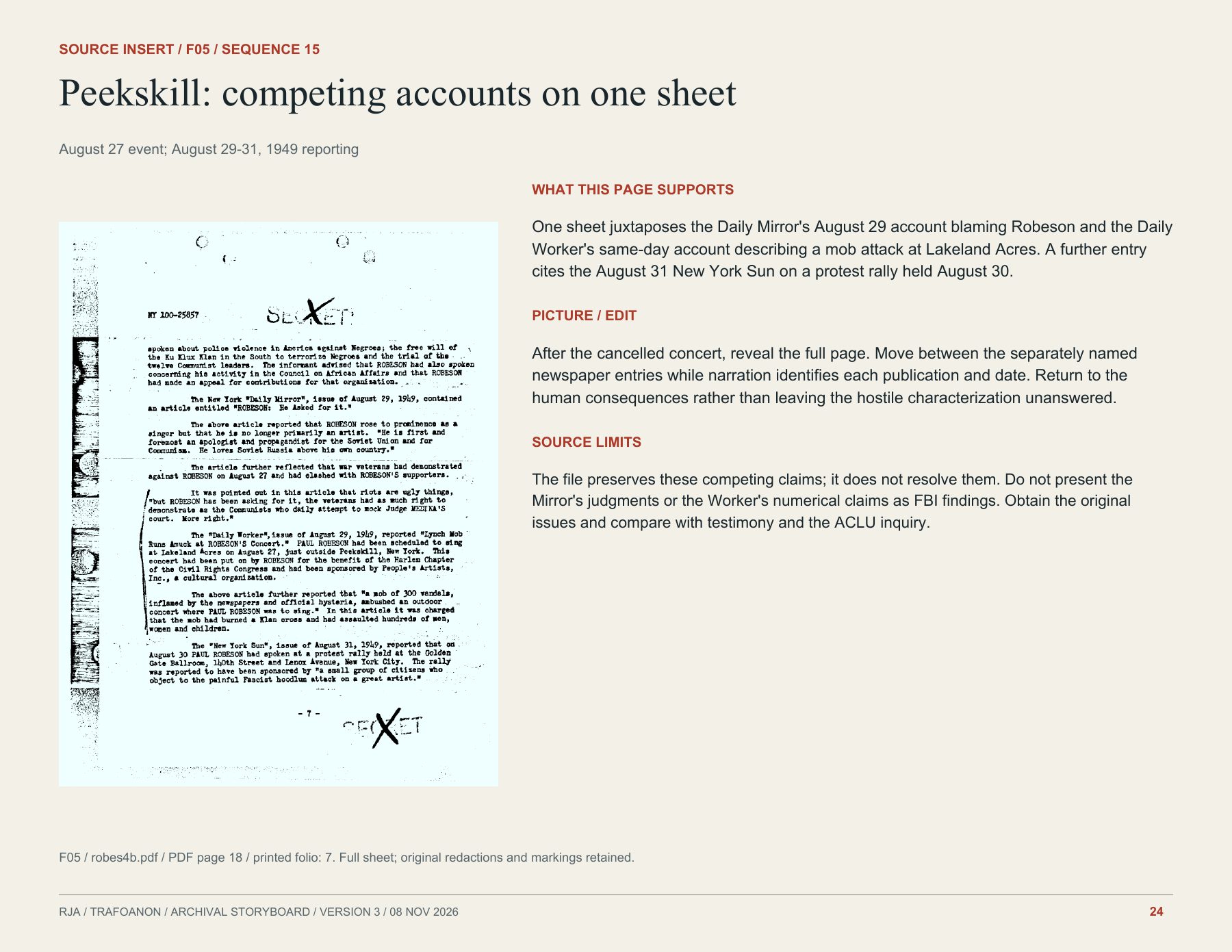
WHAT THIS PAGE SUPPORTS
One sheet juxtaposes the Daily Mirror's August 29 account blaming Robeson and the Daily
Worker's same-day account describing a mob attack at Lakeland Acres. A further entry
cites the August 31 New York Sun on a protest rally held August 30.
PICTURE / EDIT
After the cancelled concert, reveal the full page. Move between the separately named
newspaper entries while narration identifies each publication and date. Return to the
human consequences rather than leaving the hostile characterization unanswered.
SOURCE LIMITS
The file preserves these competing claims; it does not resolve them. Do not present the
Mirror's judgments or the Worker's numerical claims as FBI findings. Obtain the original
issues and compare with testimony and the ACLU inquiry.
F05 / robes4b.pdf / PDF page 18 / printed folio: 7. Full sheet; original redactions and markings retained.
24
25 / The return and the road home
 Enlarge this panel
Read page 25 text
PART 3 / SEQUENCE 16 / 25:00-29:00 / 240 SEC
The return and the road home
4 September 1949
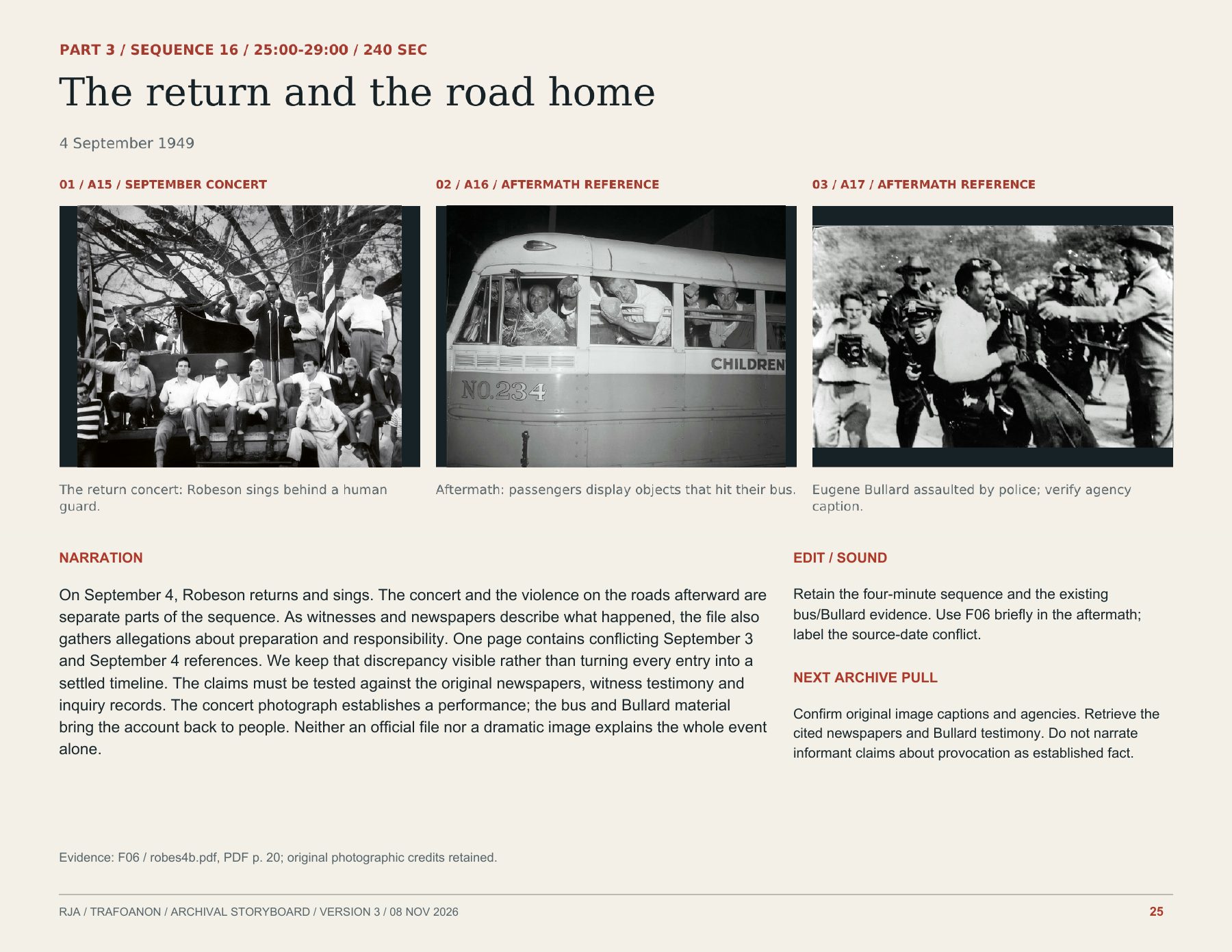
01 / A15 / SEPTEMBER CONCERT
The return concert: Robeson sings behind a human
guard.
02 / A16 / AFTERMATH REFERENCE
Aftermath: passengers display objects that hit their bus.
03 / A17 / AFTERMATH REFERENCE
Eugene Bullard assaulted by police; verify agency
caption.
NARRATION
On September 4, Robeson returns and sings. The concert and the violence on the roads afterward are separate parts of the sequence. As witnesses and newspapers describe what happened, the file also gathers allegations about preparation and responsibility. One page contains conflicting September 3 and September 4 references. We keep that discrepancy visible rather than turning every entry into a settled timeline. The claims must be tested against the original newspapers, witness testimony and inquiry records. The concert photograph establishes a performance; the bus and Bullard material bring the account back to people. Neither an official file nor a dramatic image explains the whole event alone.
EDIT / SOUND
Retain the four-minute sequence and the existing bus/Bullard evidence. Use F06 briefly in the aftermath; label the source-date conflict.
NEXT ARCHIVE PULL
Confirm original image captions and agencies. Retrieve the cited newspapers and Bullard testimony. Do not narrate informant claims about provocation as established fact.
26 / F06 The return concert: audit the dates
 Enlarge this panel
Read page 26 text
SOURCE INSERT / F06 / SEQUENCE 16
The return concert: audit the dates
September 1949 reporting; internal date conflict
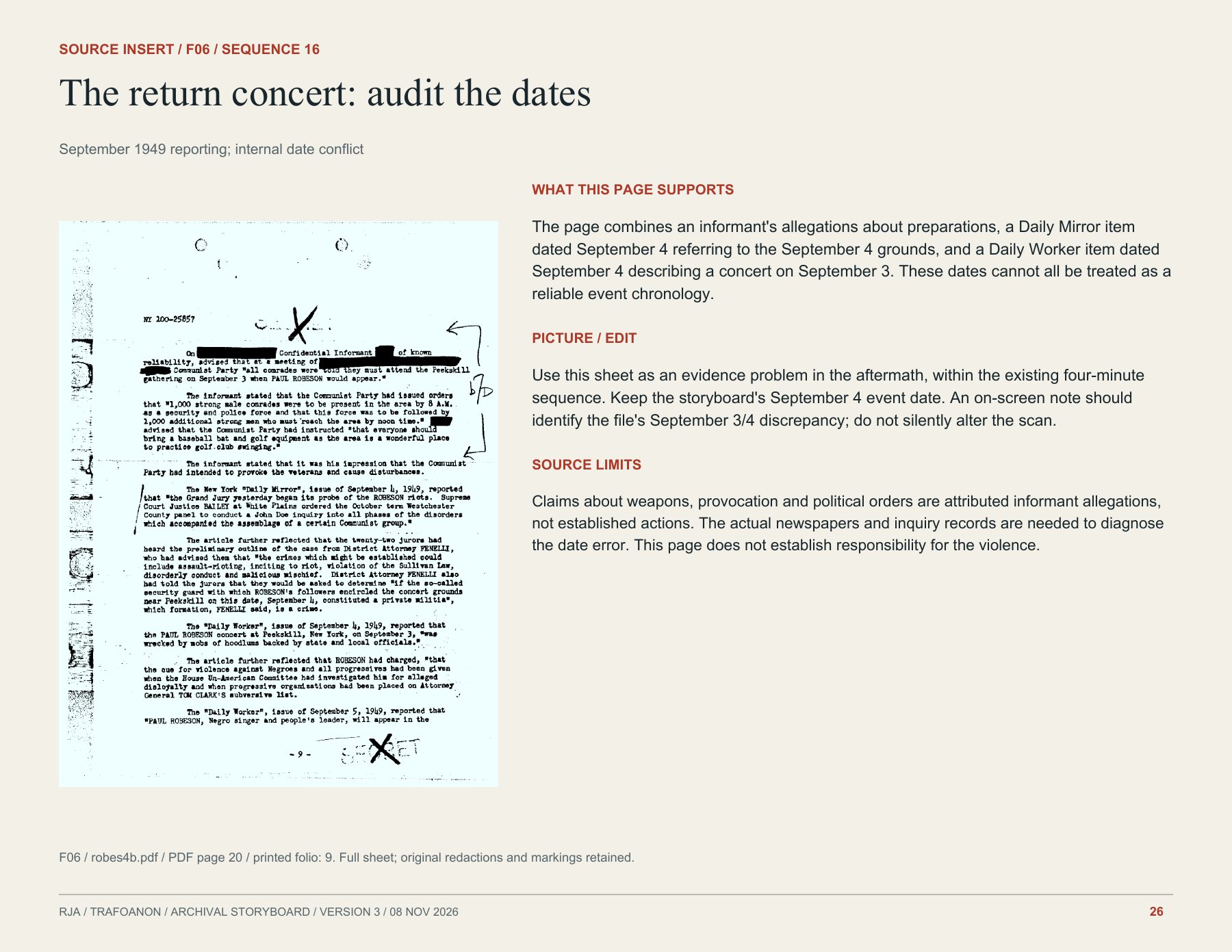
WHAT THIS PAGE SUPPORTS
The page combines an informant's allegations about preparations, a Daily Mirror item
dated September 4 referring to the September 4 grounds, and a Daily Worker item dated
September 4 describing a concert on September 3. These dates cannot all be treated as a
reliable event chronology.
PICTURE / EDIT
Use this sheet as an evidence problem in the aftermath, within the existing four-minute
sequence. Keep the storyboard's September 4 event date. An on-screen note should
identify the file's September 3/4 discrepancy; do not silently alter the scan.
SOURCE LIMITS
Claims about weapons, provocation and political orders are attributed informant allegations,
not established actions. The actual newspapers and inquiry records are needed to diagnose
the date error. This page does not establish responsibility for the violence.
F06 / robes4b.pdf / PDF page 20 / printed folio: 9. Full sheet; original redactions and markings retained.
26
27 / A platform withheld; an account contested
 Enlarge this panel
Read page 27 text
PART 3 / SEQUENCE 17 / 29:00-30:30 / 90 SEC
A platform withheld; an account contested
March-June 1950
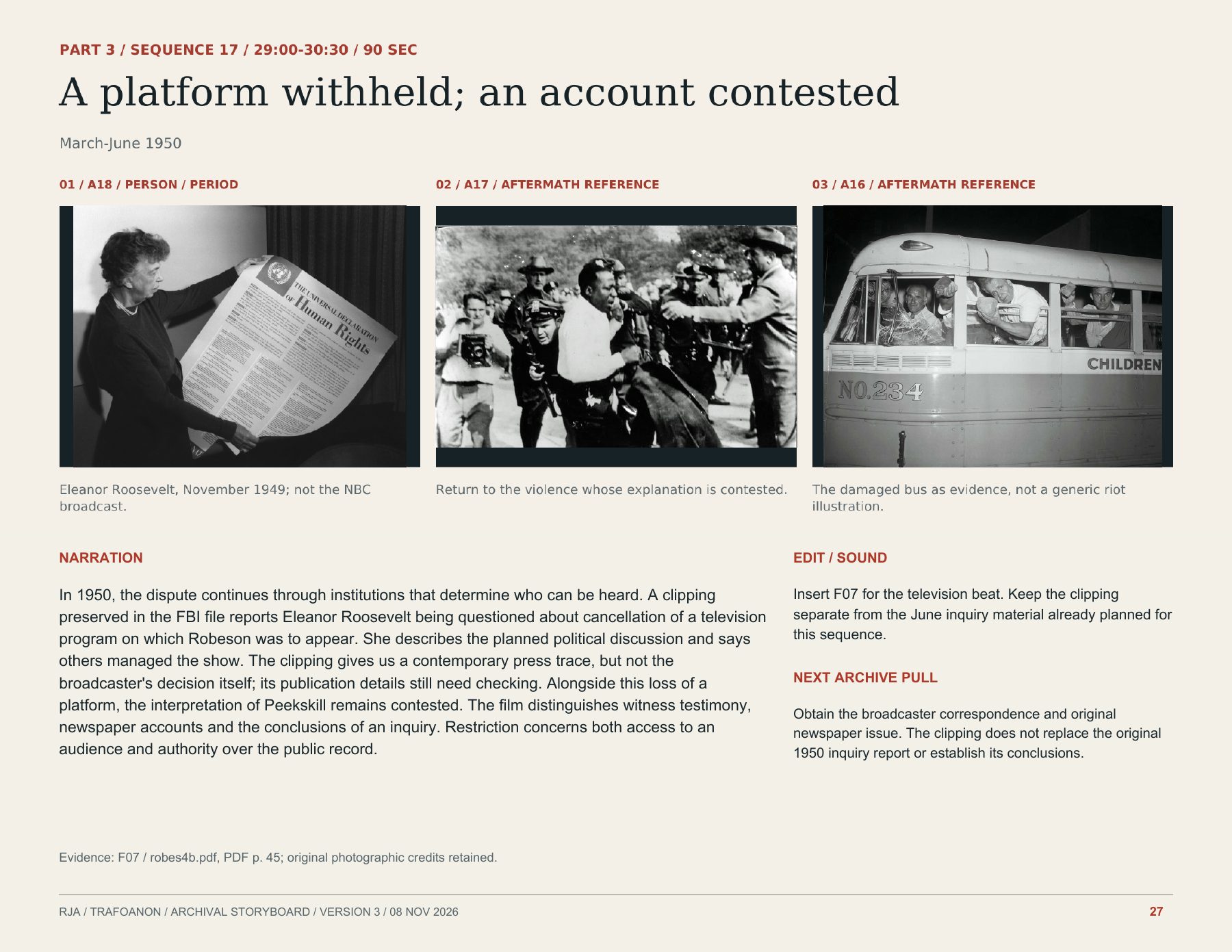
01 / A18 / PERSON / PERIOD
Eleanor Roosevelt, November 1949; not the NBC
broadcast.
02 / A17 / AFTERMATH REFERENCE
Return to the violence whose explanation is contested.
03 / A16 / AFTERMATH REFERENCE
The damaged bus as evidence, not a generic riot
illustration.
NARRATION
In 1950, the dispute continues through institutions that determine who can be heard. A clipping preserved in the FBI file reports Eleanor Roosevelt being questioned about cancellation of a television program on which Robeson was to appear. She describes the planned political discussion and says others managed the show. The clipping gives us a contemporary press trace, but not the broadcaster's decision itself; its publication details still need checking. Alongside this loss of a platform, the interpretation of Peekskill remains contested. The film distinguishes witness testimony, newspaper accounts and the conclusions of an inquiry. Restriction concerns both access to an audience and authority over the public record.
EDIT / SOUND
Insert F07 for the television beat. Keep the clipping separate from the June inquiry material already planned for this sequence.
NEXT ARCHIVE PULL
Obtain the broadcaster correspondence and original newspaper issue. The clipping does not replace the original 1950 inquiry report or establish its conclusions.
28 / F07 A television platform withdrawn
 Enlarge this panel
Read page 28 text
SOURCE INSERT / F07 / SEQUENCE 17
A television platform withdrawn
March 15 dateline; publication details incomplete
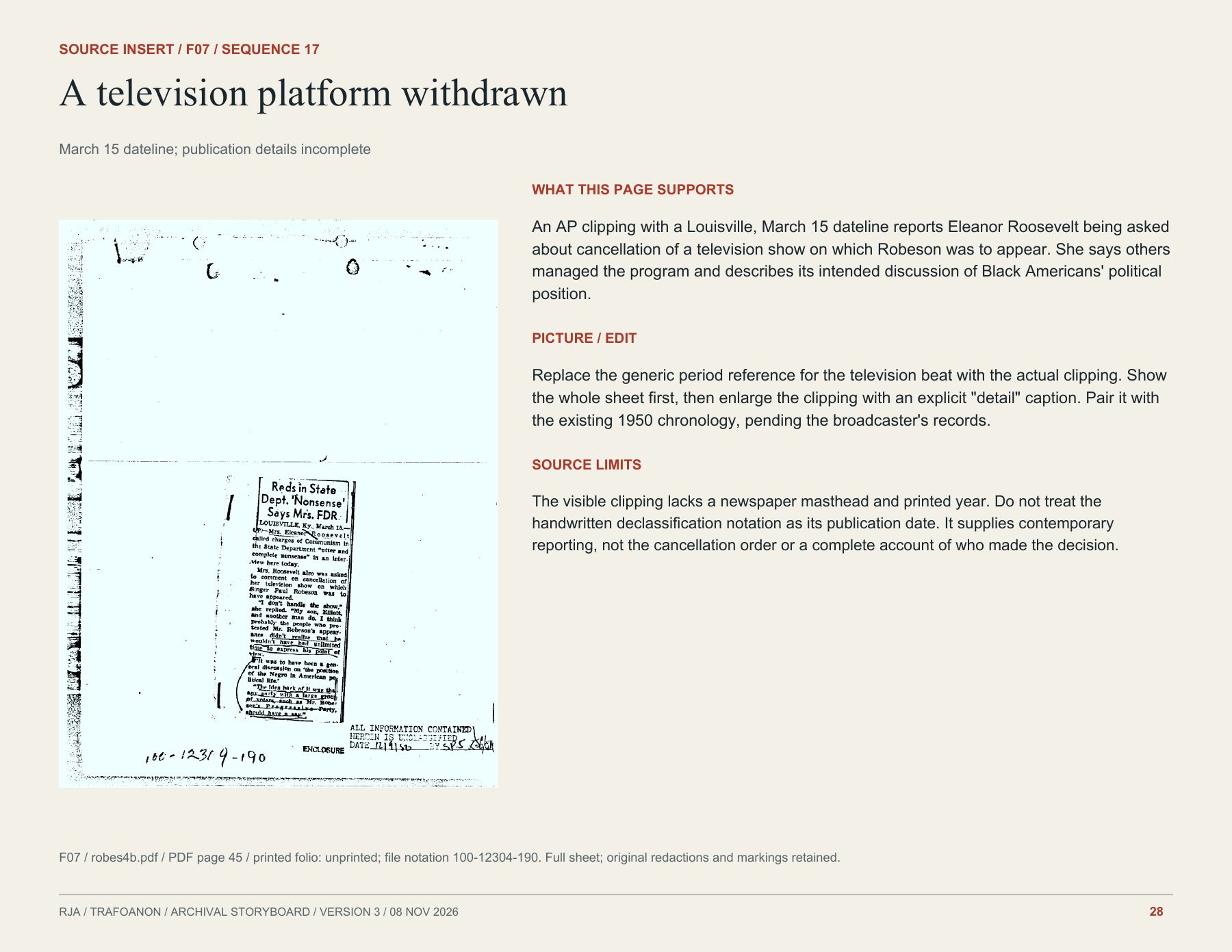
WHAT THIS PAGE SUPPORTS
An AP clipping with a Louisville, March 15 dateline reports Eleanor Roosevelt being asked
about cancellation of a television show on which Robeson was to appear. She says others
managed the program and describes its intended discussion of Black Americans' political
position.
PICTURE / EDIT
Replace the generic period reference for the television beat with the actual clipping. Show
the whole sheet first, then enlarge the clipping with an explicit "detail" caption. Pair it with
the existing 1950 chronology, pending the broadcaster's records.
SOURCE LIMITS
The visible clipping lacks a newspaper masthead and printed year. Do not treat the
handwritten declassification notation as its publication date. It supplies contemporary
reporting, not the cancellation order or a complete account of who made the decision.
F07 / robes4b.pdf / PDF page 45 / printed folio: unprinted; file notation 100-12304-190. Full sheet; original redactions and markings retained.
28
29 / The passport and the printed voice
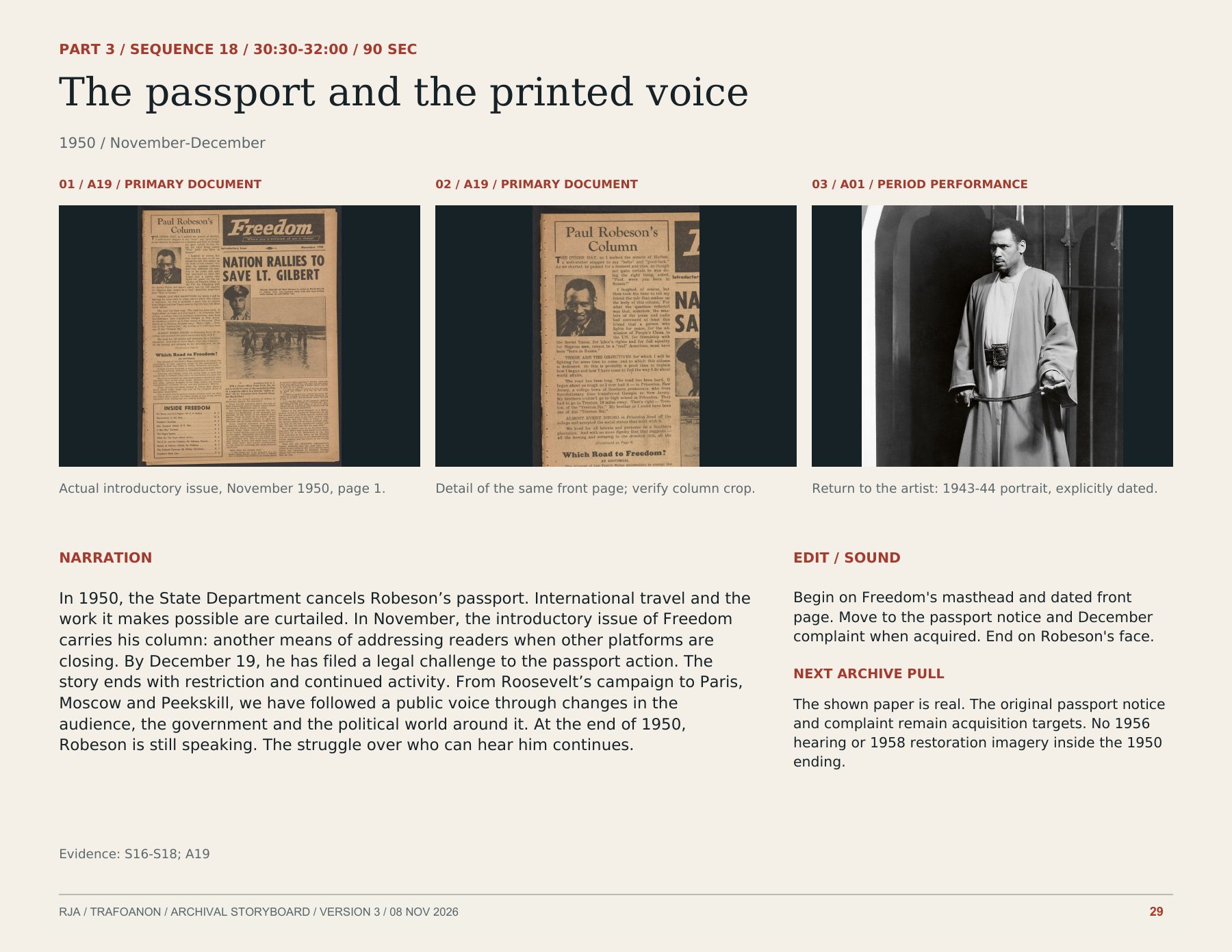 Enlarge this panel
Read page 29 text
PART 3 / SEQUENCE 18 / 30:30-32:00 / 90 SEC
The passport and the printed voice
1950 / November-December
21
01 / A19 / PRIMARY DOCUMENT
Actual introductory issue, November 1950, page 1.
02 / A19 / PRIMARY DOCUMENT
Detail of the same front page; verify column crop.
03 / A01 / PERIOD PERFORMANCE
Return to the artist: 1943-44 portrait, explicitly dated.
NARRATION
In 1950, the State Department cancels Robeson’s passport. International travel and the
work it makes possible are curtailed. In November, the introductory issue of Freedom
carries his column: another means of addressing readers when other platforms are
closing. By December 19, he has filed a legal challenge to the passport action. The
story ends with restriction and continued activity. From Roosevelt’s campaign to Paris,
Moscow and Peekskill, we have followed a public voice through changes in the
audience, the government and the political world around it. At the end of 1950,
Robeson is still speaking. The struggle over who can hear him continues.
EDIT / SOUND
Begin on Freedom's masthead and dated front
page. Move to the passport notice and December
complaint when acquired. End on Robeson's face.
NEXT ARCHIVE PULL
The shown paper is real. The original passport notice
and complaint remain acquisition targets. No 1956
hearing or 1958 restoration imagery inside the 1950
ending.
Evidence: S16-S18; A19
29
30 / Two dates. Two grounds. Different pictures.
 Enlarge this panel
Read page 30 text
PEEKSKILL / PLACE AND CONTINUITY
Two dates. Two grounds. Different pictures.
Location notes for the director, cinematographer and archive producer
22
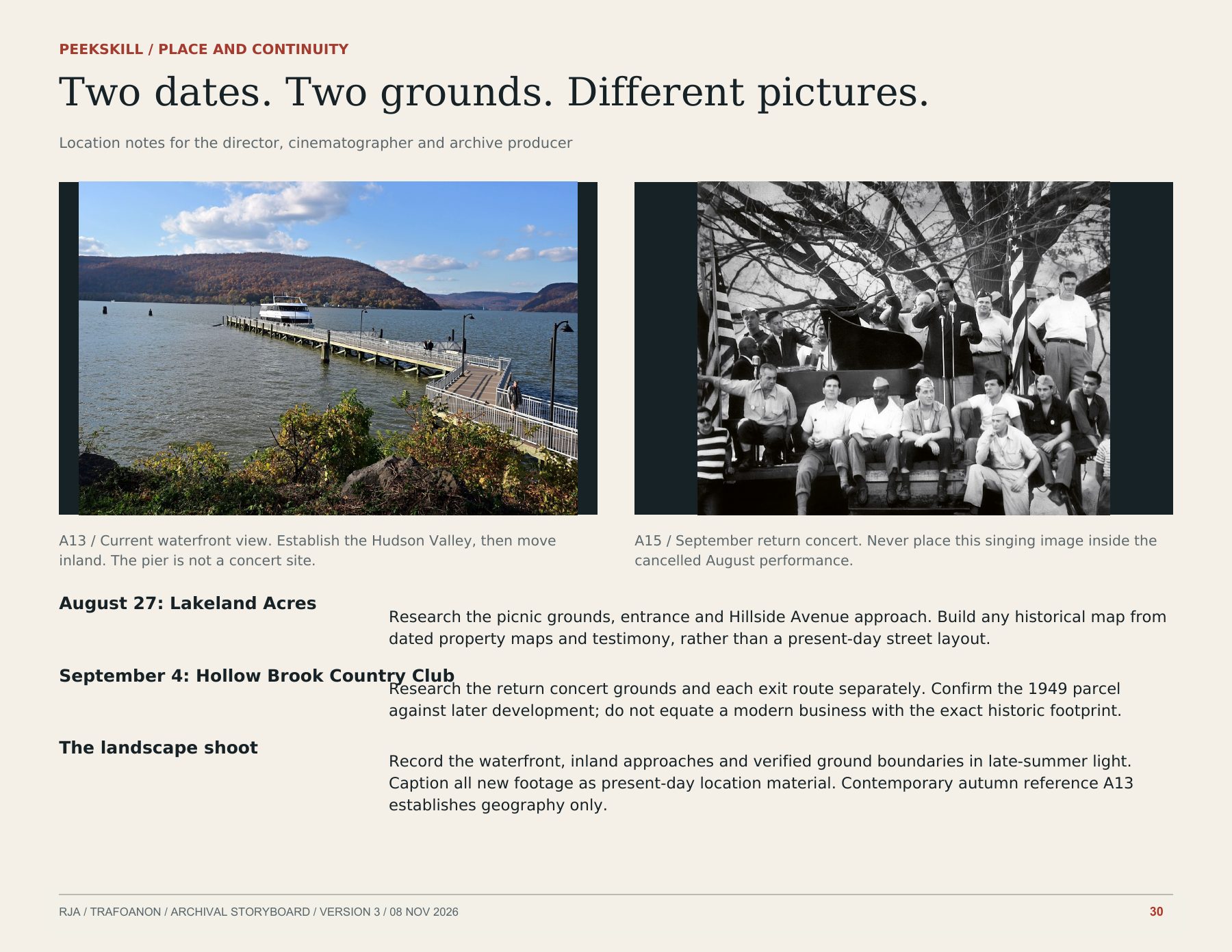
A13 / Current waterfront view. Establish the Hudson Valley, then move
inland. The pier is not a concert site.
A15 / September return concert. Never place this singing image inside the
cancelled August performance.
August 27: Lakeland Acres
Research the picnic grounds, entrance and Hillside Avenue approach. Build any historical map from
dated property maps and testimony, rather than a present-day street layout.
September 4: Hollow Brook Country Club
Research the return concert grounds and each exit route separately. Confirm the 1949 parcel
against later development; do not equate a modern business with the exact historic footprint.
The landscape shoot
Record the waterfront, inland approaches and verified ground boundaries in late-summer light.
Caption all new footage as present-day location material. Contemporary autumn reference A13
establishes geography only.
30
31 / A person, a bus, a public record.
 Enlarge this panel
Read page 31 text
PEEKSKILL / EVIDENCE FOR THE ROAD HOME
A person, a bus, a public record.
Use the aftermath to move from spectacle to an accountable sequence of events.
23
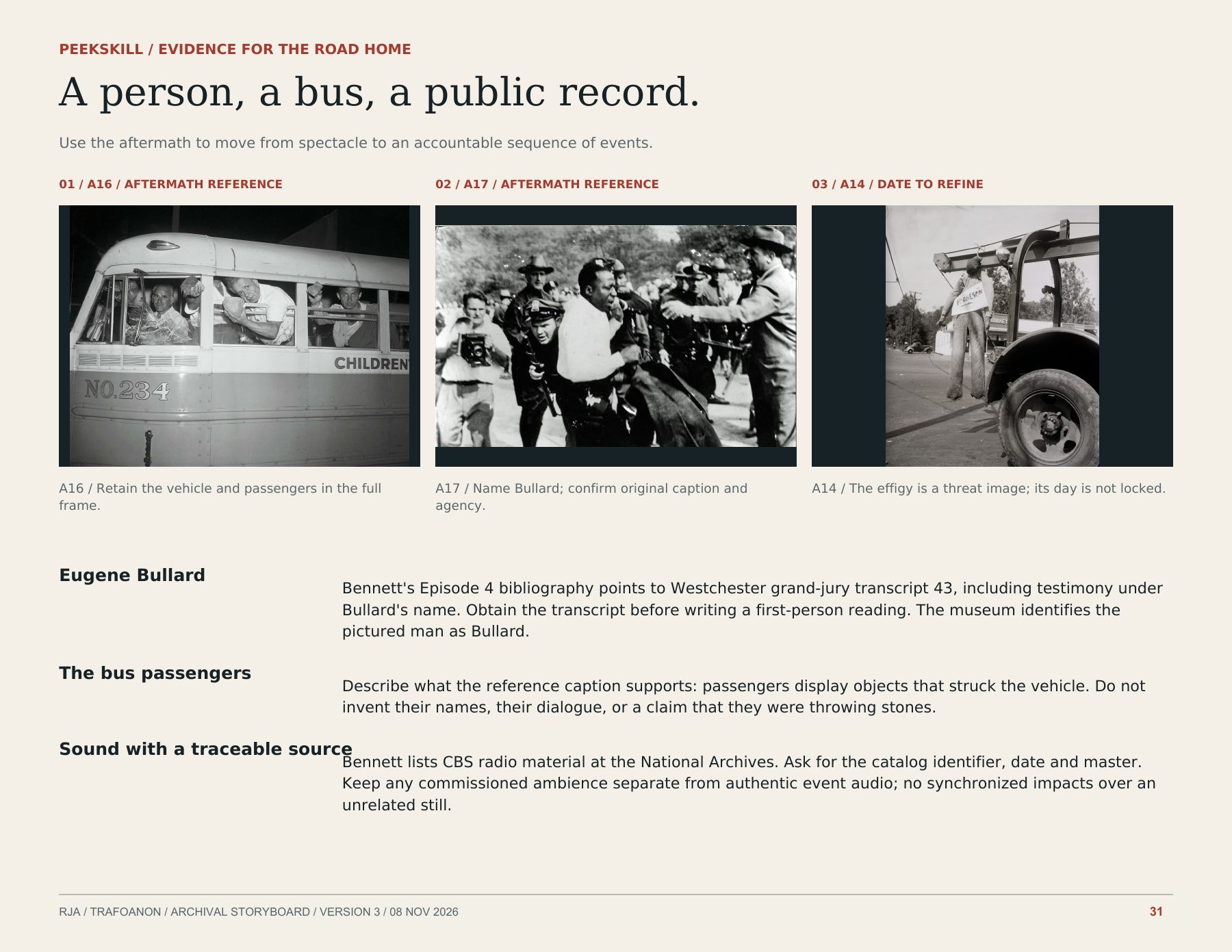
01 / A16 / AFTERMATH REFERENCE
A16 / Retain the vehicle and passengers in the full
frame.
02 / A17 / AFTERMATH REFERENCE
A17 / Name Bullard; confirm original caption and
agency.
03 / A14 / DATE TO REFINE
A14 / The effigy is a threat image; its day is not locked.
Eugene Bullard
Bennett's Episode 4 bibliography points to Westchester grand-jury transcript 43, including testimony under
Bullard's name. Obtain the transcript before writing a first-person reading. The museum identifies the
pictured man as Bullard.
The bus passengers
Describe what the reference caption supports: passengers display objects that struck the vehicle. Do not
invent their names, their dialogue, or a claim that they were throwing stones.
Sound with a traceable source
Bennett lists CBS radio material at the National Archives. Ask for the catalog identifier, date and master.
Keep any commissioned ambience separate from authentic event audio; no synchronized impacts over an
unrelated still.
31
32 / Use his research trail to build our own scenes.
 Enlarge this panel
Read page 32 text
RESEARCH / JON SCOTT BENNETT
Use his research trail to build our own scenes.
R01 / The Peekskill Riots, five-part documentary series / published episode pages consulted
24
1 / The Mighty Oak in the Forest
Biographical orientation. Use as a screening priority for the transition from celebrated artist to political target.
2 / The Friendly Town By The River
Local history. Add an inland geography and community sequence before the first attack.
3 / Up on the Hillside, Down in the Hollow
August 27. The source list identifies local newspaper issues, the ACLU report, Fast, Walwik, Duberman and contemporary government records.
4 / A Long Ways From Home
September 4. The list points to Bullard testimony, police and district-attorney reports, CBS radio and retrospective interview material.
5 / Wake Up America
Aftermath and memory. Use as a research route into the 1950 inquiry and later public remembrance; keep the film's chronology ending in
1950.
Method: these are editorial applications of the episode descriptions and bibliographies, not assertions about unseen scenes. Screen complete
episodes and create timecoded viewing notes before selecting any excerpt. Film clips and underlying archival images need separate rights
tracing.
jonscottbennett.com/films | Episode 3 and 4 pages provide the most direct acquisition leads.
32
33 / Keep interpretation visible and testable.
 Enlarge this panel
Read page 33 text
RESEARCH / SCHOLARSHIP
Keep interpretation visible and testable.
Three scholarly approaches, with the access level stated explicitly
25
R02 / Denise Lynn (2026) / full article consulted
"Violence at Peekskill! Paul Robeson, Anti-Communism, and Populist Fascism Among Veterans," Journal of Right-Wing Studies 4(1), pp. 2-29;
DOI 10.5070/RW3.39669. The article argues that veterans' anti-Robeson organizing was deliberate and locates the riots within wider efforts to
restrict radical and Black political activity. Its discussion of the concerts and inquiries is particularly useful at pp. 20-27. Treat "populist
fascism" as Lynn's analytical term, not the narrator's unexplained verdict. Her account helps frame the conflict between official explanations
and witness evidence.
Source / publication record
R03 / Joseph Walwik (2002) / publisher synopsis consulted
The Peekskill, New York, Anti-Communist Riots of 1949, Edwin Mellen Press. The publisher emphasizes local, national and international
pressures and challenges explanations based solely on political manipulation. Use this as a counter-reading to test with primary evidence. The
complete book was not available for this revision; do not imply its detailed arguments or individual page claims were verified here.
Source / publication record
R04 / Jeff Jaeckle (2019) / chapter abstract consulted
"The Peekskill Projects: Race, Riots, and Paul Robeson," pp. 90-103; DOI 10.3366/edinburgh/9781474439947.003.0006. The abstract
describes Kopple's unrealized projects and questions whether crisis-driven storytelling can flatten systemic racism. Editorial application: show
organizing, institutions and aftermath around the dramatic attacks. Full chapter still to obtain.
Source / publication record
33
34 / The next pulls have names and call numbers.
 Enlarge this panel
Read page 34 text
RESEARCH / ARCHIVES AND CORROBORATION
The next pulls have names and call numbers.
An archive guide locates evidence; it is not a substitute for reading the item.
26
R05 / NYU, Barbara Kopple Collection / TAM.307
Series VI: photographs, boxes 10-12; negatives, contact sheets and prints. Other series include official records, clippings and individual files.
Related collections: Kopple oral histories, OH 002.4, and Daily Worker / Daily World photographs, PHOTOS 223. Seek August and September item
captions separately. NYU says it cannot grant copyright permission for these materials.
Source / archive guide
R06 / Maxim Matusevich / Moscow interpretation
Seton Hall historical essay, 8 November 2015. Useful for examining Robeson's Soviet commitments and the Feffer account. Private dialogue and
gestures are retrospective reconstructions. Do not inherit the essay's compressed execution language as a 1949 event: Feffer was executed in
1952.
Source / archive guide
R07 / Rutgers and Jewish cultural history
Andrea Alexander's 2019 interview with historian Nancy Sinkoff supplies a scholarly perspective on Robeson's alliance with the Jewish left and its
contradictions. Its archival photo caption identifies Feffer at left, Robeson center and Mikhoels right in 1943. The source photograph is credited to
Jewish Public Library Archives, Montreal.
Source / archive guide
R08 / Jackie Robinson Museum / Howard Bryant
The museum publishes an excerpt from Kings and Pawns and identifies the July 18, 1949 HUAC appearance. Use it to locate the full testimony and
to preserve Robinson's circumstances rather than turning the scene into an invented personal feud.
Source / archive guide
34
35 / Compare the inquiries rather than collapsing them.
 Enlarge this panel
Read page 35 text
RESEARCH / COMPETING RECORDS
Compare the inquiries rather than collapsing them.
A production reading list for the August-September events and their 1950 retelling
27
American Civil Liberties Union, Violence in Peekskill (1949)
A contemporary civil-liberties inquiry, not a detached later synthesis. Read the complete report alongside testimony and police records. Bennett's
episode lists provide page leads; the full report has not been independently examined here.
Westchester grand-jury report and testimony (1950)
Separate witness testimony from the final report's conclusions. Bennett points to transcript 43 for Bullard. Lynn discusses the report's June 1950
release and its interpretation of responsibility. Pull the original report before recording a quotation.
Howard Fast, Peekskill USA (1951; later reprints)
An involved participant's account. Useful for an attributed eyewitness voice, with contemporaneous records as a check. It is not a neutral official
record, and its later publication date should remain visible.
Matthew Schuerman, Smithsonian Magazine (27 August 2024)
A researched public-history account using grand-jury testimony, police reports and newspapers. Its account of the August grounds and entrance
helps plan a location sequence. Use the underlying material for precise action and quoted language.
Martin Duberman, Paul Robeson: A Biography (1988/1989 editions)
A major biographical acquisition priority for the larger arc. Bennett's list cites the Peekskill discussion. Full relevant chapters and edition-specific
pagination still need checking; no unseen passage is treated as verified here.
Schuerman article / Library of Congress event overview
35
36 / Images 01-05: credits and uses.
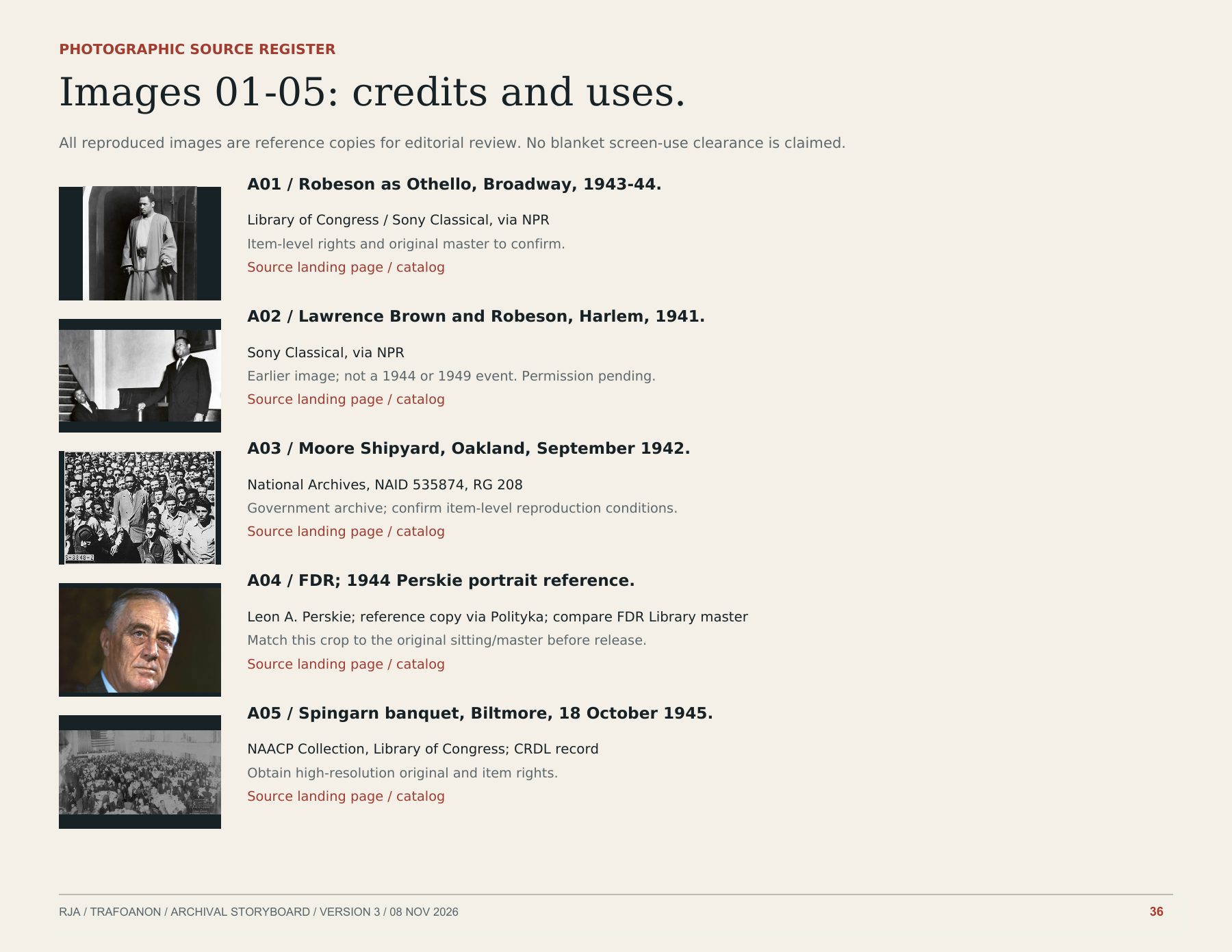 Enlarge this panel
Read page 36 text
PHOTOGRAPHIC SOURCE REGISTER
Images 01-05: credits and uses.
All reproduced images are reference copies for editorial review. No blanket screen-use clearance is claimed.
28
A01 / Robeson as Othello, Broadway, 1943-44.
Library of Congress / Sony Classical, via NPR
Item-level rights and original master to confirm.
Source landing page / catalog
A02 / Lawrence Brown and Robeson, Harlem, 1941.
Sony Classical, via NPR
Earlier image; not a 1944 or 1949 event. Permission pending.
Source landing page / catalog
A03 / Moore Shipyard, Oakland, September 1942.
National Archives, NAID 535874, RG 208
Government archive; confirm item-level reproduction conditions.
Source landing page / catalog
A04 / FDR; 1944 Perskie portrait reference.
Leon A. Perskie; reference copy via Polityka; compare FDR Library master
Match this crop to the original sitting/master before release.
Source landing page / catalog
A05 / Spingarn banquet, Biltmore, 18 October 1945.
NAACP Collection, Library of Congress; CRDL record
Obtain high-resolution original and item rights.
Source landing page / catalog
36
37 / Images 06-10: credits and uses.
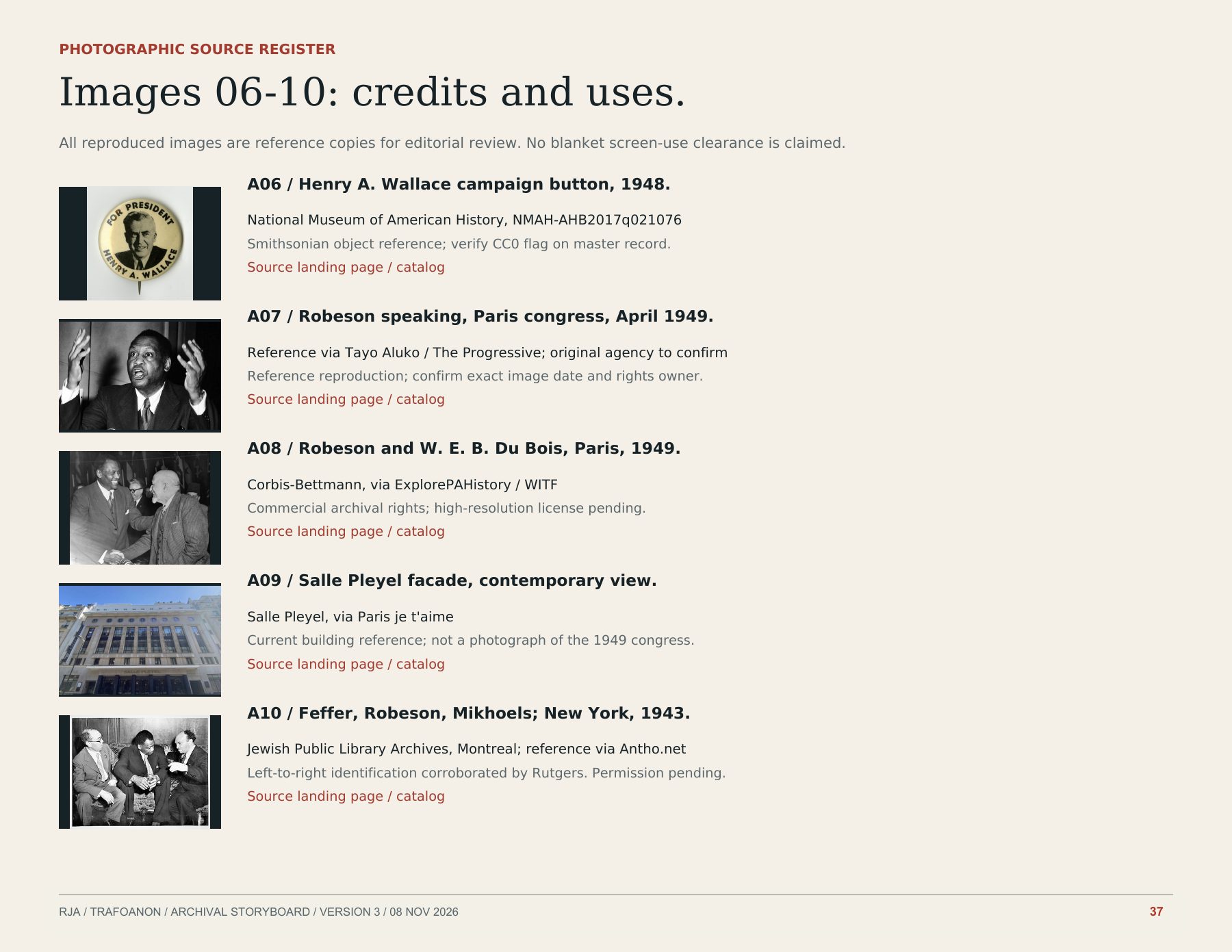 Enlarge this panel
Read page 37 text
PHOTOGRAPHIC SOURCE REGISTER
Images 06-10: credits and uses.
All reproduced images are reference copies for editorial review. No blanket screen-use clearance is claimed.
29
A06 / Henry A. Wallace campaign button, 1948.
National Museum of American History, NMAH-AHB2017q021076
Smithsonian object reference; verify CC0 flag on master record.
Source landing page / catalog
A07 / Robeson speaking, Paris congress, April 1949.
Reference via Tayo Aluko / The Progressive; original agency to confirm
Reference reproduction; confirm exact image date and rights owner.
Source landing page / catalog
A08 / Robeson and W. E. B. Du Bois, Paris, 1949.
Corbis-Bettmann, via ExplorePAHistory / WITF
Commercial archival rights; high-resolution license pending.
Source landing page / catalog
A09 / Salle Pleyel facade, contemporary view.
Salle Pleyel, via Paris je t'aime
Current building reference; not a photograph of the 1949 congress.
Source landing page / catalog
A10 / Feffer, Robeson, Mikhoels; New York, 1943.
Jewish Public Library Archives, Montreal; reference via Antho.net
Left-to-right identification corroborated by Rutgers. Permission pending.
Source landing page / catalog
37
38 / Images 11-15: credits and uses.
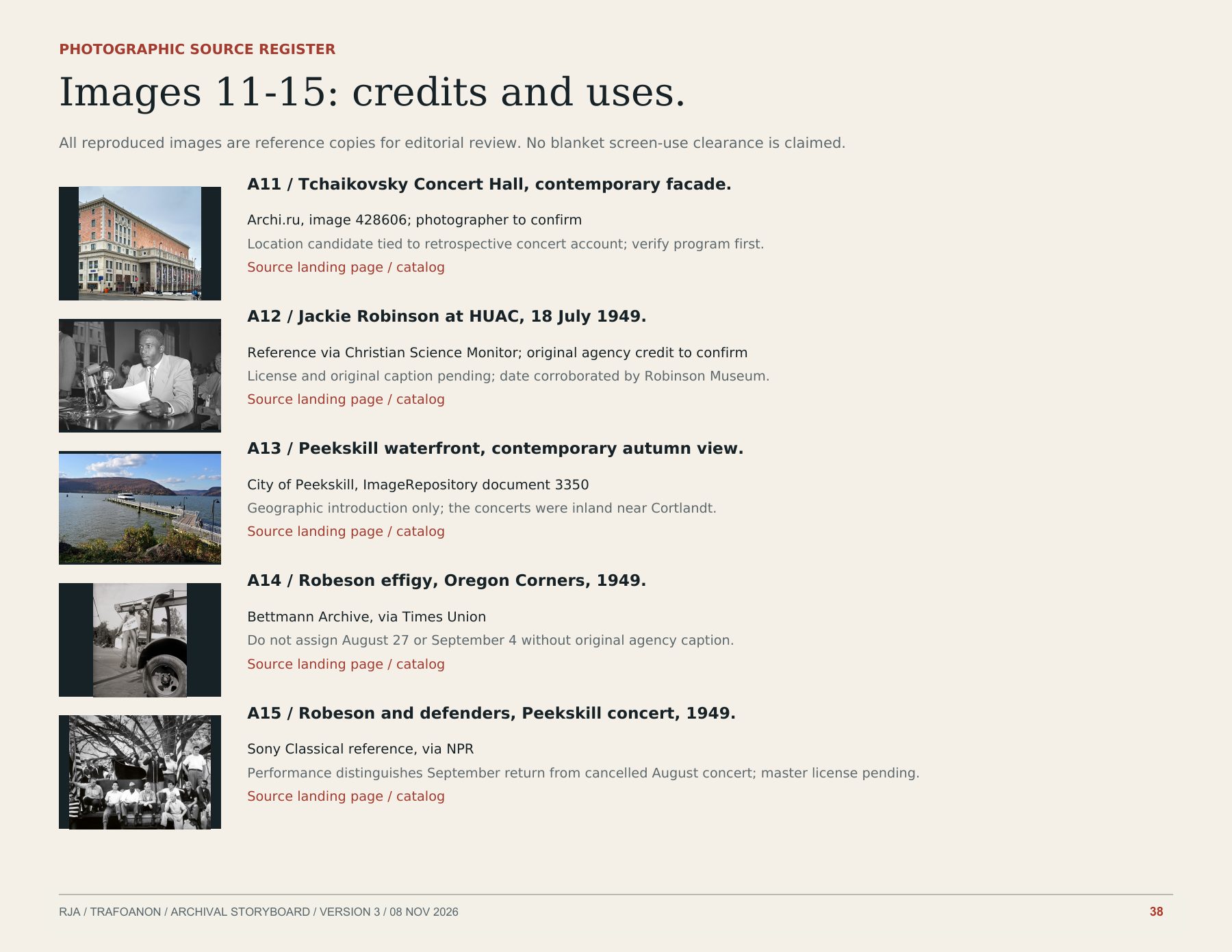 Enlarge this panel
Read page 38 text
PHOTOGRAPHIC SOURCE REGISTER
Images 11-15: credits and uses.
All reproduced images are reference copies for editorial review. No blanket screen-use clearance is claimed.
30
A11 / Tchaikovsky Concert Hall, contemporary facade.
Archi.ru, image 428606; photographer to confirm
Location candidate tied to retrospective concert account; verify program first.
Source landing page / catalog
A12 / Jackie Robinson at HUAC, 18 July 1949.
Reference via Christian Science Monitor; original agency credit to confirm
License and original caption pending; date corroborated by Robinson Museum.
Source landing page / catalog
A13 / Peekskill waterfront, contemporary autumn view.
City of Peekskill, ImageRepository document 3350
Geographic introduction only; the concerts were inland near Cortlandt.
Source landing page / catalog
A14 / Robeson effigy, Oregon Corners, 1949.
Bettmann Archive, via Times Union
Do not assign August 27 or September 4 without original agency caption.
Source landing page / catalog
A15 / Robeson and defenders, Peekskill concert, 1949.
Sony Classical reference, via NPR
Performance distinguishes September return from cancelled August concert; master license pending.
Source landing page / catalog
38
39 / Images 16-19: credits and uses.
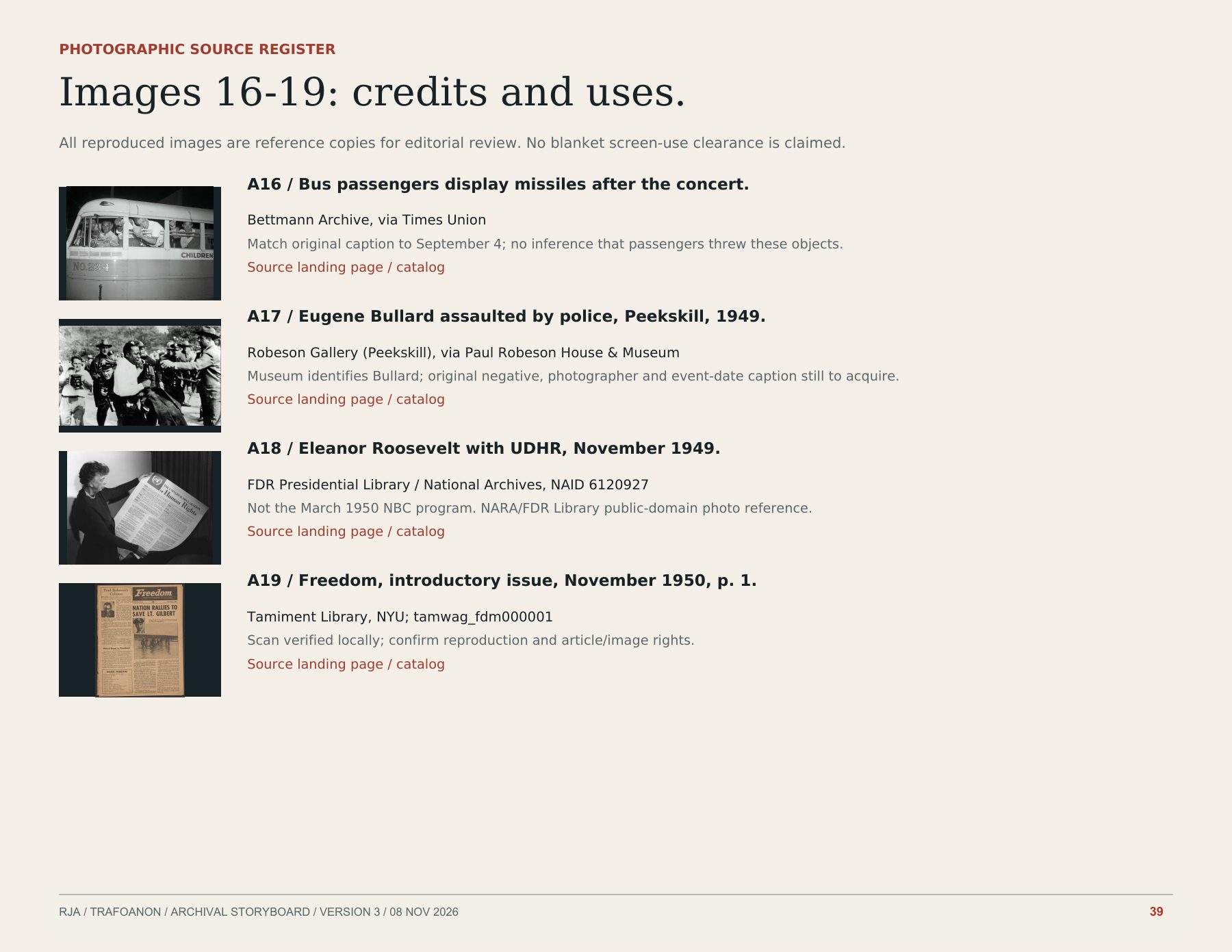 Enlarge this panel
Read page 39 text
PHOTOGRAPHIC SOURCE REGISTER
Images 16-19: credits and uses.
All reproduced images are reference copies for editorial review. No blanket screen-use clearance is claimed.
31
A16 / Bus passengers display missiles after the concert.
Bettmann Archive, via Times Union
Match original caption to September 4; no inference that passengers threw these objects.
Source landing page / catalog
A17 / Eugene Bullard assaulted by police, Peekskill, 1949.
Robeson Gallery (Peekskill), via Paul Robeson House & Museum
Museum identifies Bullard; original negative, photographer and event-date caption still to acquire.
Source landing page / catalog
A18 / Eleanor Roosevelt with UDHR, November 1949.
FDR Presidential Library / National Archives, NAID 6120927
Not the March 1950 NBC program. NARA/FDR Library public-domain photo reference.
Source landing page / catalog
A19 / Freedom, introductory issue, November 1950, p. 1.
Tamiment Library, NYU; tamwag_fdm000001
Scan verified locally; confirm reproduction and article/image rights.
Source landing page / catalog
39
40 / Evidence register 1
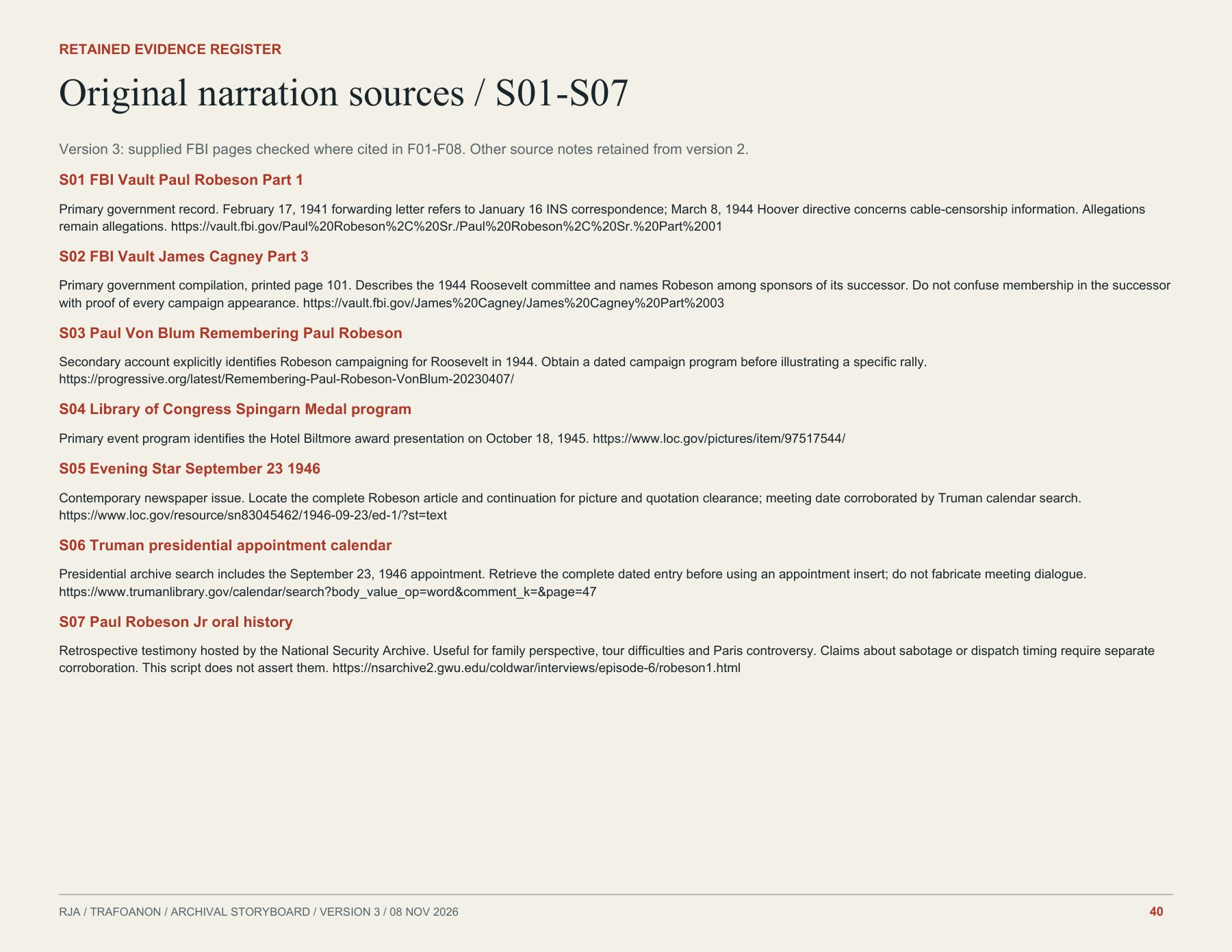 Enlarge this panel
Read page 40 text
RETAINED EVIDENCE REGISTER
Original narration sources / S01-S07
Version 3: supplied FBI pages checked where cited in F01-F08. Other source notes retained from version 2.
S01 FBI Vault Paul Robeson Part 1
Primary government record. February 17, 1941 forwarding letter refers to January 16 INS correspondence; March 8, 1944 Hoover directive concerns cable-censorship information. Allegations
remain allegations. https://vault.fbi.gov/Paul%20Robeson%2C%20Sr./Paul%20Robeson%2C%20Sr.%20Part%2001
S02 FBI Vault James Cagney Part 3
Primary government compilation, printed page 101. Describes the 1944 Roosevelt committee and names Robeson among sponsors of its successor. Do not confuse membership in the successor
with proof of every campaign appearance. https://vault.fbi.gov/James%20Cagney/James%20Cagney%20Part%2003
S03 Paul Von Blum Remembering Paul Robeson
Secondary account explicitly identifies Robeson campaigning for Roosevelt in 1944. Obtain a dated campaign program before illustrating a specific rally.
https://progressive.org/latest/Remembering-Paul-Robeson-VonBlum-20230407/
S04 Library of Congress Spingarn Medal program
Primary event program identifies the Hotel Biltmore award presentation on October 18, 1945. https://www.loc.gov/pictures/item/97517544/
S05 Evening Star September 23 1946
Contemporary newspaper issue. Locate the complete Robeson article and continuation for picture and quotation clearance; meeting date corroborated by Truman calendar search.
https://www.loc.gov/resource/sn83045462/1946-09-23/ed-1/?st=text
S06 Truman presidential appointment calendar
Presidential archive search includes the September 23, 1946 appointment. Retrieve the complete dated entry before using an appointment insert; do not fabricate meeting dialogue.
https://www.trumanlibrary.gov/calendar/search?body_value_op=word&comment_k=&page=47
S07 Paul Robeson Jr oral history
Retrospective testimony hosted by the National Security Archive. Useful for family perspective, tour difficulties and Paris controversy. Claims about sabotage or dispatch timing require separate
corroboration. This script does not assert them. https://nsarchive2.gwu.edu/coldwar/interviews/episode-6/robeson1.html
40
41 / Evidence register 2
 Enlarge this panel
Read page 41 text
RETAINED EVIDENCE REGISTER
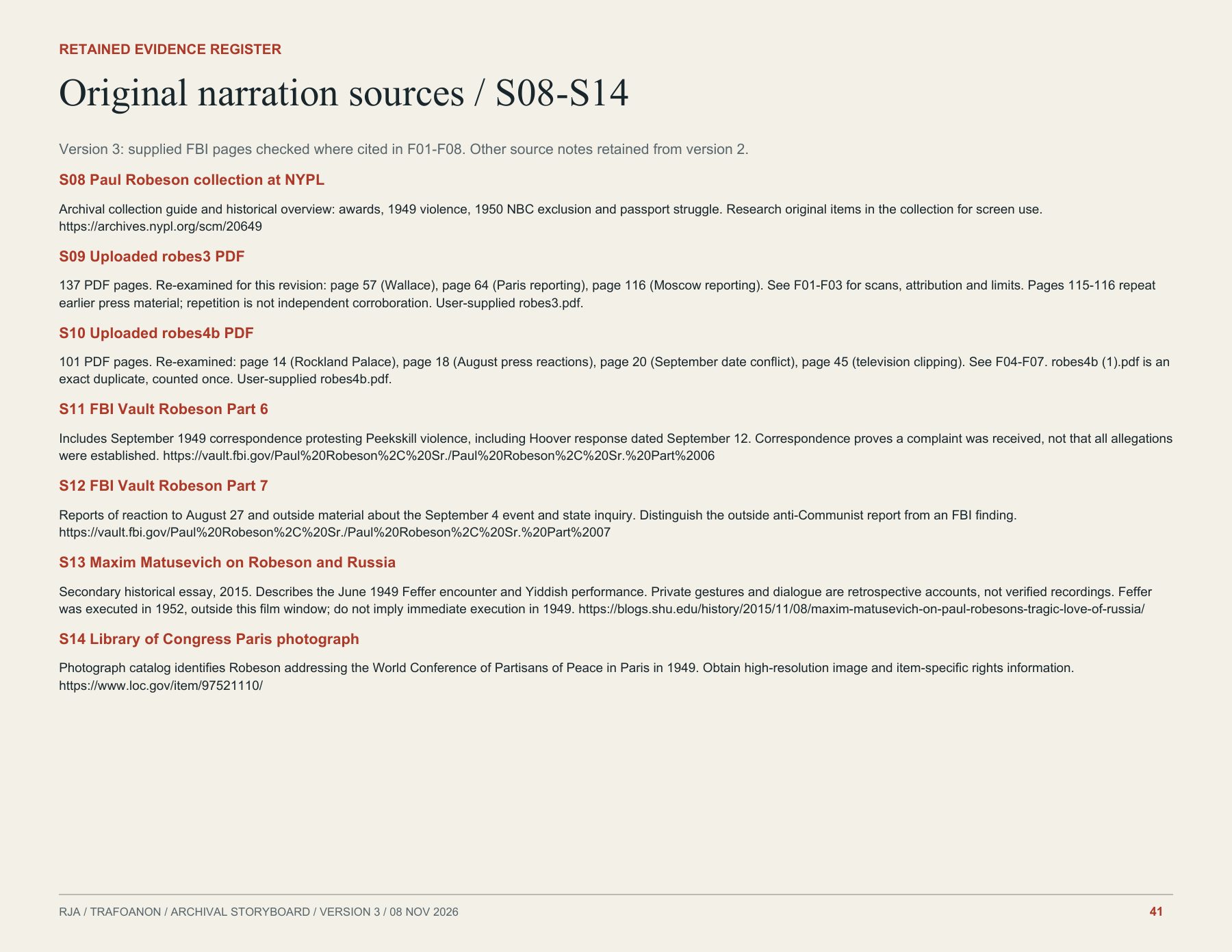
Original narration sources / S08-S14
Version 3: supplied FBI pages checked where cited in F01-F08. Other source notes retained from version 2.
S08 Paul Robeson collection at NYPL
Archival collection guide and historical overview: awards, 1949 violence, 1950 NBC exclusion and passport struggle. Research original items in the collection for screen use.
https://archives.nypl.org/scm/20649
S09 Uploaded robes3 PDF
137 PDF pages. Re-examined for this revision: page 57 (Wallace), page 64 (Paris reporting), page 116 (Moscow reporting). See F01-F03 for scans, attribution and limits. Pages 115-116 repeat
earlier press material; repetition is not independent corroboration. User-supplied robes3.pdf.
S10 Uploaded robes4b PDF
101 PDF pages. Re-examined: page 14 (Rockland Palace), page 18 (August press reactions), page 20 (September date conflict), page 45 (television clipping). See F04-F07. robes4b (1).pdf is an
exact duplicate, counted once. User-supplied robes4b.pdf.
S11 FBI Vault Robeson Part 6
Includes September 1949 correspondence protesting Peekskill violence, including Hoover response dated September 12. Correspondence proves a complaint was received, not that all allegations
were established. https://vault.fbi.gov/Paul%20Robeson%2C%20Sr./Paul%20Robeson%2C%20Sr.%20Part%2006
S12 FBI Vault Robeson Part 7
Reports of reaction to August 27 and outside material about the September 4 event and state inquiry. Distinguish the outside anti-Communist report from an FBI finding.
https://vault.fbi.gov/Paul%20Robeson%2C%20Sr./Paul%20Robeson%2C%20Sr.%20Part%2007
S13 Maxim Matusevich on Robeson and Russia
Secondary historical essay, 2015. Describes the June 1949 Feffer encounter and Yiddish performance. Private gestures and dialogue are retrospective accounts, not verified recordings. Feffer
was executed in 1952, outside this film window; do not imply immediate execution in 1949. https://blogs.shu.edu/history/2015/11/08/maxim-matusevich-on-paul-robesons-tragic-love-of-russia/
S14 Library of Congress Paris photograph
Photograph catalog identifies Robeson addressing the World Conference of Partisans of Peace in Paris in 1949. Obtain high-resolution image and item-specific rights information.
https://www.loc.gov/item/97521110/
41
42 / Evidence register 3
 Enlarge this panel
Read page 42 text
RETAINED EVIDENCE REGISTER
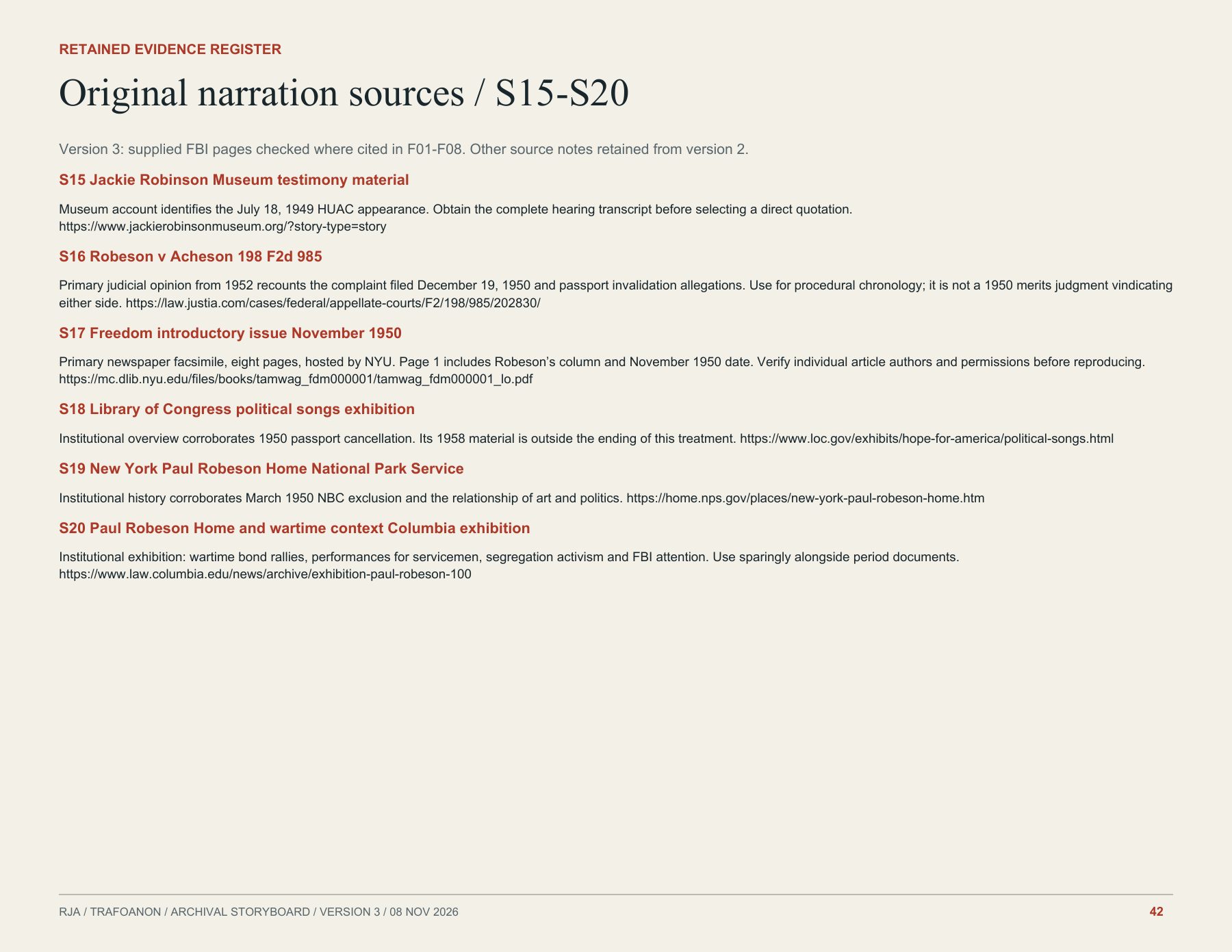
Original narration sources / S15-S20
Version 3: supplied FBI pages checked where cited in F01-F08. Other source notes retained from version 2.
S15 Jackie Robinson Museum testimony material
Museum account identifies the July 18, 1949 HUAC appearance. Obtain the complete hearing transcript before selecting a direct quotation.
https://www.jackierobinsonmuseum.org/?story-type=story
S16 Robeson v Acheson 198 F2d 985
Primary judicial opinion from 1952 recounts the complaint filed December 19, 1950 and passport invalidation allegations. Use for procedural chronology; it is not a 1950 merits judgment vindicating
either side. https://law.justia.com/cases/federal/appellate-courts/F2/198/985/202830/
S17 Freedom introductory issue November 1950
Primary newspaper facsimile, eight pages, hosted by NYU. Page 1 includes Robeson’s column and November 1950 date. Verify individual article authors and permissions before reproducing.
https://mc.dlib.nyu.edu/files/books/tamwag_fdm000001/tamwag_fdm000001_lo.pdf
S18 Library of Congress political songs exhibition
Institutional overview corroborates 1950 passport cancellation. Its 1958 material is outside the ending of this treatment. https://www.loc.gov/exhibits/hope-for-america/political-songs.html
S19 New York Paul Robeson Home National Park Service
Institutional history corroborates March 1950 NBC exclusion and the relationship of art and politics. https://home.nps.gov/places/new-york-paul-robeson-home.htm
S20 Paul Robeson Home and wartime context Columbia exhibition
Institutional exhibition: wartime bond rallies, performances for servicemen, segregation activism and FBI attention. Use sparingly alongside period documents.
https://www.law.columbia.edu/news/archive/exhibition-paul-robeson-100
42
43 / F08 Later evidence: the file enters litigation
 Enlarge this panel
Read page 43 text
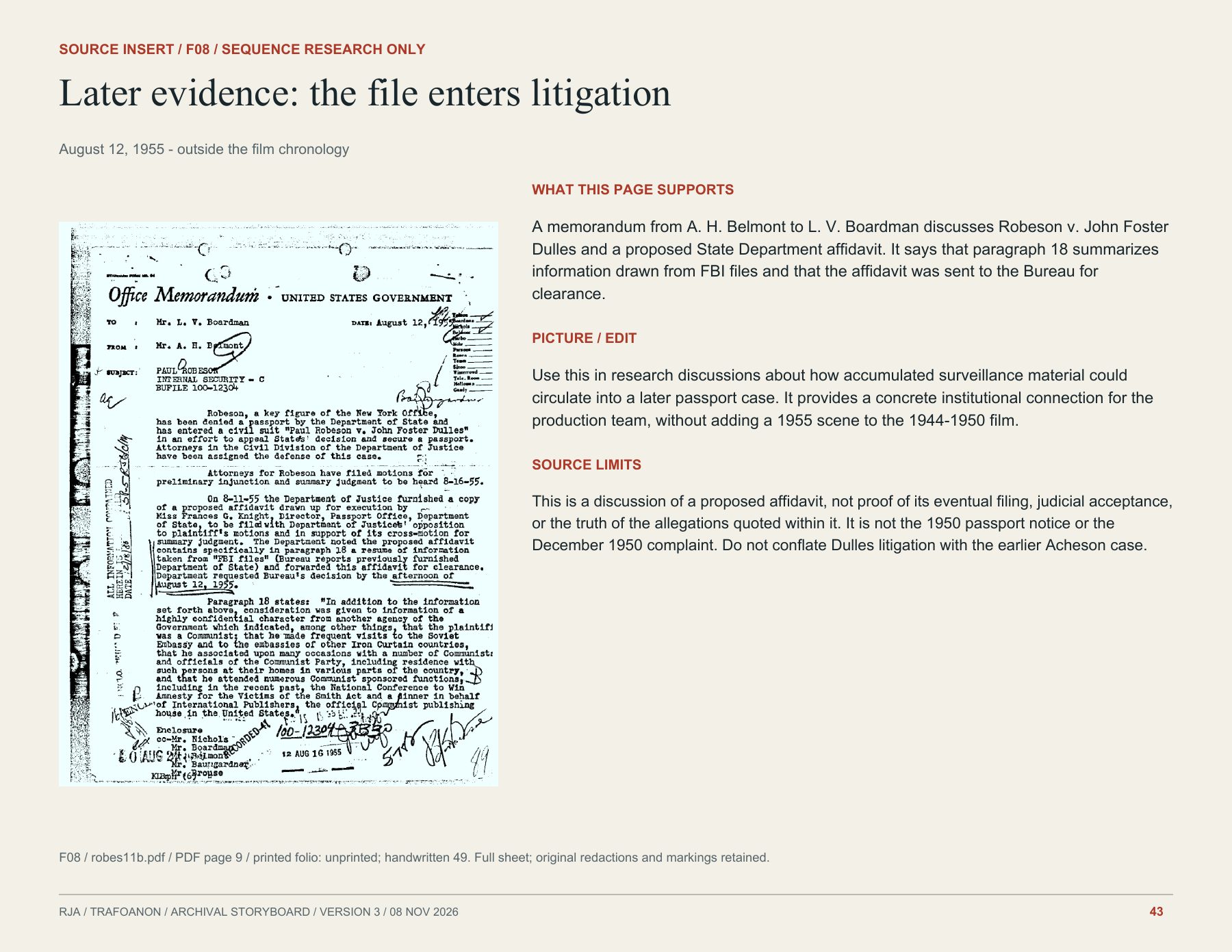
SOURCE INSERT / F08 / SEQUENCE RESEARCH ONLY
Later evidence: the file enters litigation
August 12, 1955 - outside the film chronology
WHAT THIS PAGE SUPPORTS
A memorandum from A. H. Belmont to L. V. Boardman discusses Robeson v. John Foster
Dulles and a proposed State Department affidavit. It says that paragraph 18 summarizes
information drawn from FBI files and that the affidavit was sent to the Bureau for
clearance.
PICTURE / EDIT
Use this in research discussions about how accumulated surveillance material could
circulate into a later passport case. It provides a concrete institutional connection for the
production team, without adding a 1955 scene to the 1944-1950 film.
SOURCE LIMITS
This is a discussion of a proposed affidavit, not proof of its eventual filing, judicial acceptance,
or the truth of the allegations quoted within it. It is not the 1950 passport notice or the
December 1950 complaint. Do not conflate Dulles litigation with the earlier Acheson case.
F08 / robes11b.pdf / PDF page 9 / printed folio: unprinted; handwritten 49. Full sheet; original redactions and markings retained.
43
44 / Production handoff
 Enlarge this panel
Read page 44 text
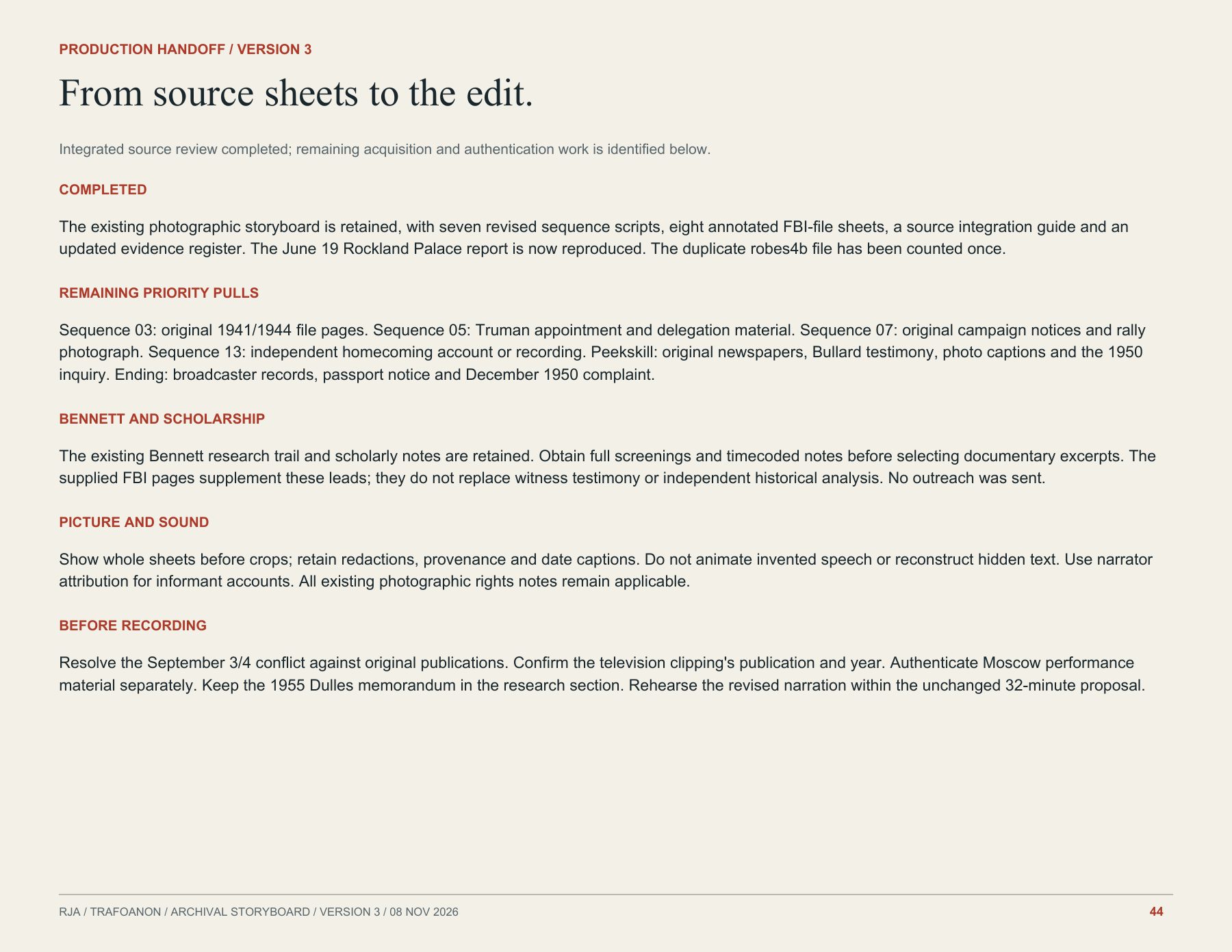
PRODUCTION HANDOFF / VERSION 3
From source sheets to the edit.
Integrated source review completed; remaining acquisition and authentication work is identified below.
COMPLETED
The existing photographic storyboard is retained, with seven revised sequence scripts, eight annotated FBI-file sheets, a source integration guide and an
updated evidence register. The June 19 Rockland Palace report is now reproduced. The duplicate robes4b file has been counted once.
REMAINING PRIORITY PULLS
Sequence 03: original 1941/1944 file pages. Sequence 05: Truman appointment and delegation material. Sequence 07: original campaign notices and rally
photograph. Sequence 13: independent homecoming account or recording. Peekskill: original newspapers, Bullard testimony, photo captions and the 1950
inquiry. Ending: broadcaster records, passport notice and December 1950 complaint.
BENNETT AND SCHOLARSHIP
The existing Bennett research trail and scholarly notes are retained. Obtain full screenings and timecoded notes before selecting documentary excerpts. The
supplied FBI pages supplement these leads; they do not replace witness testimony or independent historical analysis. No outreach was sent.
PICTURE AND SOUND
Show whole sheets before crops; retain redactions, provenance and date captions. Do not animate invented speech or reconstruct hidden text. Use narrator
attribution for informant accounts. All existing photographic rights notes remain applicable.
BEFORE RECORDING
Resolve the September 3/4 conflict against original publications. Confirm the television clipping's publication and year. Authenticate Moscow performance
material separately. Keep the 1955 Dulles memorandum in the research section. Rehearse the revised narration within the unchanged 32-minute proposal.
44
Collaborate with the film
For research contributions, archival leads, collaboration or funding inquiries, contact the production team.
Contact production Return to The Film